We often praise flexibility. In yoga studios, dance academies, and gymnastic rings across Vadodara, individuals who can effortlessly slide into deep splits, twist their torsos, or bend their thumbs back to touch their forearms are viewed with envy. Society often labels these individuals as lucky, inherently agile, or simply “double-jointed.”
However, in the clinical world of orthopaedics and sports medicine, extreme flexibility without corresponding muscle strength is not a superpower—it is a structural vulnerability.
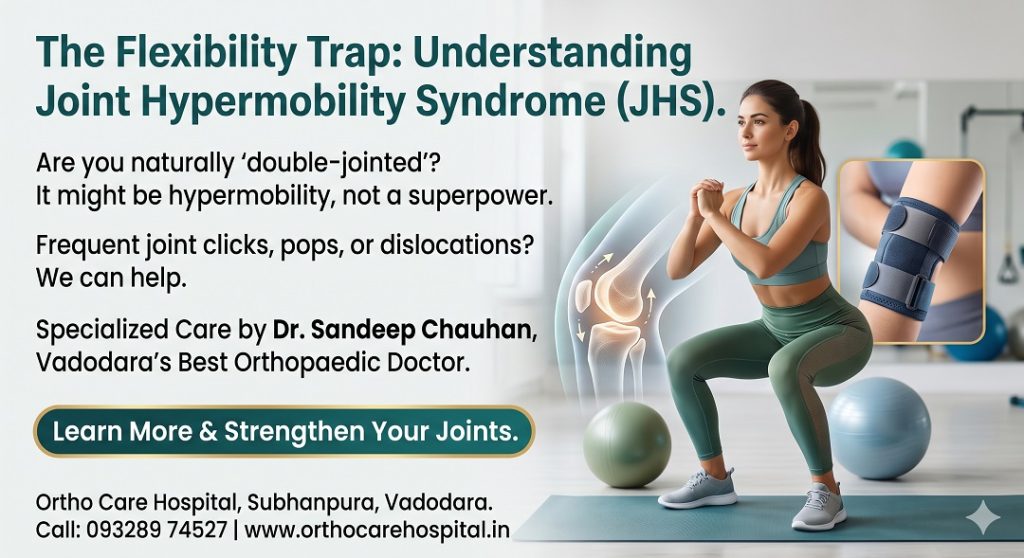
If your joints frequently click, pop, or shift out of alignment, or if you have a history of repeated ankle sprains from simply walking on flat surfaces, you may be living with Joint Hypermobility Syndrome (JHS). While being flexible is generally healthy, pathologically loose joints lack the natural “brakes” needed to protect your skeletal structure. Over time, this instability can lead to chronic pain, recurrent subluxations (partial dislocations), and early-onset arthritis.
At Ortho Care Hospital, we regularly treat patients who have spent years managing unexplained body aches, fatigue, and joint instability. Under the clinical guidance of Dr. Sandeep Chauhan, the Best Orthopaedic Doctor in Vadodara, we specialize in transforming hypermobile joints from a source of vulnerability into a foundation for stable, confident movement through targeted neuromuscular stabilization.
What is Joint Hypermobility Syndrome?
To understand hypermobility, we must examine the connective tissue that holds the human body together. Joints are formed where two bones meet. To prevent these bones from sliding out of place, they are bound together by tough, fibrous bands of tissue called ligaments.
In a typical individual, ligaments act like thick, taut nylon straps. They allow a safe, normal range of motion but stiffen up immediately to protect the joint from overextending.
In individuals with Joint Hypermobility Syndrome, the genetic blueprint for creating collagen—the primary structural protein in ligaments, tendons, and joint capsules—is slightly altered. The collagen fibers are inherently more elastic, behaving more like stretchy rubber bands than rigid nylon straps.
Because the mechanical “seatbelts” of the joints are loose, the bones can travel far beyond normal anatomical boundaries. While “double-jointedness” implies having extra joints, this is a myth; hypermobile individuals have the exact same number of joints as everyone else—their stabilizing tissues are simply loose.
The Beighton Score: Testing for Hypermobility
In clinical practice at our Subhanpura clinic, Dr. Sandeep Chauhan uses a universally recognized screening tool called the Beighton Score to objectively measure systemic joint laxity. This is a 9-point scoring system that assesses specific movements across the body:
| Assessment Description | Right Side | Left Side |
| Can you bend your pinky finger backward past $90^\circ$? | 1 Point | 1 Point |
| Can you pull your thumb down to touch your inner forearm? | 1 Point | 1 Point |
| Does your elbow hyperextend backward past $10^\circ$? | 1 Point | 1 Point |
| Does your knee hyperextend backward past $10^\circ$? | 1 Point | 1 Point |
| Can you bend forward and place your flat palms flat on the floor without bending your knees? | 1 Point (Total) |
- Scoring Matrix: A score of 4 or higher out of 9 typically indicates systemic joint hypermobility. When this laxity is accompanied by widespread musculoskeletal pain lasting longer than three months, it progresses to a clinical diagnosis of Joint Hypermobility Syndrome or Hypermobile Ehlers-Danlos Syndrome (hEDS).
The Path to Damage: Instability and Early-Onset Arthritis
Many young individuals enjoy their hypermobility because it gives them an edge in performance arts or athletics. However, ignoring the underlying lack of structural stability sets up a long-term degenerative cycle:
1. Proprioceptive Blindness
Inside healthy ligaments are microscopic nerve endings called proprioceptors. These sensors act as the body’s internal GPS, constantly feeding real-time data back to the brain regarding the exact position, angle, and speed of your joints.
In hypermobile individuals, because the ligaments are loose and stretched out, these sensors fail to fire accurately. The brain effectively operates with a “blind spot,” unaware that a joint is overextending until a structural injury occurs. This explains why hypermobile individuals are prone to frequent, clumsy trips, micro-traumas, and recurrent sprains.
2. Micro-Trauma and Cartilage Shear
Every joint surface is lined with a smooth, glass-like layer of articular cartilage designed to absorb shock and facilitate frictionless movement.
When a joint is stable, the bones rotate perfectly along a fixed axis. When a joint is hypermobile and loose, the bones undergo a subtle sliding, shifting, or grinding motion during movement. This abnormal sliding creates shear stress across the delicate cartilage, scraping away microscopic layers over time.
3. Accelerated Structural Failure
Because the passive ligaments cannot support the joint, the surrounding muscles are forced to work overtime to keep the bones inside their sockets. This leads to chronic muscular fatigue, tight knots, and spasming muscles that feel perpetually “stiff” despite the underlying joint looseness.
Eventually, as the cartilage erodes completely from years of micro-subluxations, early-onset osteoarthritis manifests, causing permanent pain and stiffness in individuals who are often only in their 20s or 30s.
Recognizing the Systemic Symptoms of JHS
Joint Hypermobility Syndrome is a systemic connective tissue condition, meaning its impact is rarely confined to a single joint. Common indicators include:
- Frequent Joint Clicks and Pops: Joints constantly snap or grind during normal movements as tendons slide over loose bony prominences.
- Recurrent Subluxations: The shoulder, knee cap, or jaw feels like it momentarily slips out of place before popping back in.
- Persistent Joint and Muscle Fatigue: Waking up feeling sore and exhausted because the muscles worked all night just to maintain joint alignment.
- Delayed Healing Timelines: Minor sprains or strains take months to heal because the inherently stretchy tissues struggle to form dense, rigid scar tissue.
The Solution: Targeted Neuromuscular Stabilization
The traditional approach to joint pain—stretching, yoga, or aggressive flexibility drills—is highly counterproductive for someone with hypermobility. Stretching already loose ligaments further destabilizes the skeleton.
At Ortho Care Hospital, Dr. Sandeep Chauhan implements a specialized, comprehensive rehabilitation framework centered around dynamic stabilization:
[Avoid Passive Stretching] ➔ [Train Proprioception (Balance)] ➔ [Build Closed-Chain Strength]
     Ligaments are loose          Re-program brain's GPS         Muscles act as new "brakes"
1. Proprioceptive Re-Education
We utilize specialized balance boards, foam pads, and perturbation training to retrain the brain’s internal sensors. By teaching the nervous system to recognize where the joint is before it hyperextends, we stop injuries before they happen.
2. Closed-Chain Isometric Strengthening
Instead of using heavy free weights through long, loose ranges of motion, we focus on closed-kinetic-chain exercises (where the hand or foot is fixed to a solid surface, such as walls or floors). We emphasize high-repetition isometric holds to build endurance in the deep stabilizing muscles—such as the rotator cuff in the shoulder or the gluteus medius in the hip. These muscles must act as the new, manual “brakes” for your joints.
3. Splints, Braces, and Kinetic Taping
During acute flare-ups, we use specialized compression garments or kinesiology taping. The tape provides immediate tactile feedback to the skin, acting as an artificial proprioceptor that alerts the patient whenever a joint begins to overextend.
Strengthen Your Joints Today
Being “double-jointed” does not mean you are fated to live with chronic pain or face early-onset arthritis. By shifting your focus from flexibility to stability, you can build a resilient musculoskeletal system that supports you safely through life.
If you are tired of dealing with loose, clicking joints or recurrent sprains, visit Ortho Care Hospital for an objective evaluation and a structured dynamic stabilization program designed specifically for hypermobile bodies.
Contact Ortho Care Hospital:
- Website: www.orthocarehospital.in
- Phone No: 093289 74527
- Address: 2nd Floor Sharnam Enclave, Above Kotak Bank, Subhanpura Main Road, New IPCL Road, Vadodara, 390023.