It starts with a sharp pinch when you reach for a glass on the top shelf, or perhaps a dull, nagging ache that keeps you from finding a comfortable sleeping position at night. For many in Vadodara, shoulder pain is often dismissed as “just a pull” or “sleeping the wrong way.” However, your shoulder is the most mobile joint in your body, and that mobility relies on a delicate set of four muscles and tendons known as the Rotator Cuff.
At Ortho Care Hospital, we frequently see patients who have spent months trying to “work through” the pain, only to find their arm becoming increasingly weak or even “frozen.” Under the clinical direction of Dr. Sandeep Chauhan, the Best Orthopaedic Surgeon in Vadodara, we specialize in differentiating between a minor strain and a significant tear, ensuring you get the right treatment before the damage becomes permanent.
What Exactly is the Rotator Cuff?
Think of the rotator cuff as the “glue” that holds your arm in its socket. It is comprised of four main muscles that transition into tendons, attaching to the head of the humerus (upper arm bone):
- Supraspinatus: Helps lift your arm out to the side (the most commonly injured).
- Infraspinatus: Allows you to rotate your arm outward.
- Teres Minor: Also assists in outward rotation.
- Subscapularis: Allows you to rotate your arm inward toward your stomach.
When these tendons are healthy, they provide a smooth, powerful range of motion. When they are injured, even simple tasks like brushing your hair or reaching into your back pocket can become agonizing.
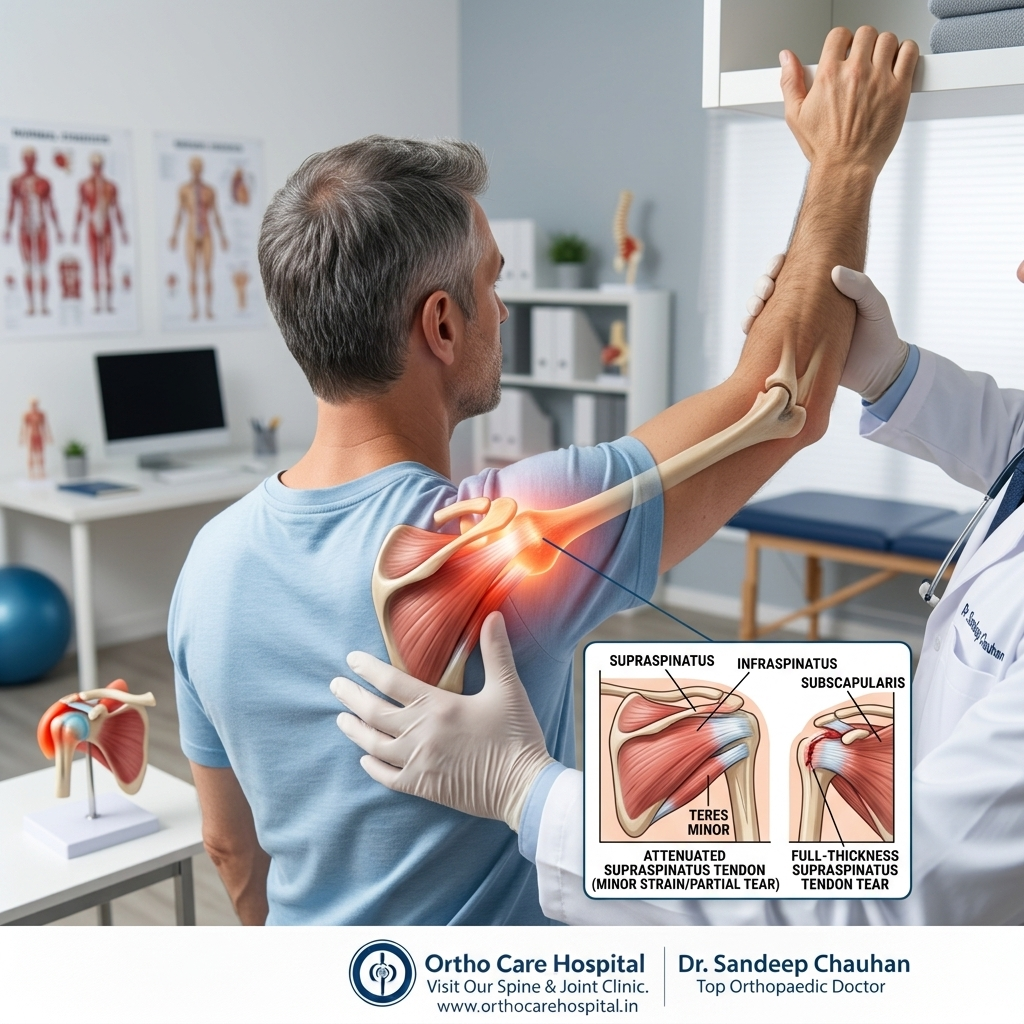
Strain vs. Tear: Understanding the Spectrum
Not all shoulder pain is created equal. Understanding where your injury falls on the spectrum is critical for recovery.
1. Rotator Cuff Strain (The “Overstretched” Tendon)
A strain occurs when the tendons are overstretched or microscopic fibers are frayed, but the tendon remains physically attached to the bone.
- The Feeling: A dull ache, especially after activity.
- The Cause: Repetitive overhead motions (painting, tennis, or lifting weights).
- The Recovery: Usually responds well to rest, physical therapy, and anti-inflammatory care.
2. Partial-Thickness Tear
In this case, the tendon is damaged but not completely severed. It’s like a rope that has started to fray; it’s still holding on, but it’s significantly weakened.
3. Full-Thickness (Complete) Tear
This is a “hole” in the tendon. The tissue has pulled away from the bone entirely.
- The Feeling: Sudden weakness. You may find it physically impossible to lift your arm to the side, regardless of how much pain you can tolerate.
- The Danger: Unlike a strain, a full-thickness tear will not heal on its own. Over time, the muscle attached to that tendon can “atrophy” or turn into fat, making a later repair much more difficult.
The “Frozen” Risk: Why Early Intervention Matters
One of the biggest risks of ignoring a rotator cuff injury is the development of Adhesive Capsulitis, commonly known as Frozen Shoulder.
When your rotator cuff hurts, you naturally stop moving your shoulder to avoid the pain. This lack of movement causes the joint capsule to thicken and tighten. Eventually, the shoulder becomes so stiff that you cannot move it even if you try. By the time a patient reaches this “frozen” state, the recovery process becomes much longer and more complex.
Comprehensive Treatment Options
At Ortho Care Hospital, our goal is to match the treatment to the severity of the injury.
- Regenerative Therapy: For strains and partial tears, we focus on strengthening the surrounding muscles and using advanced therapy to stimulate natural healing.
- Arthroscopic Repair: If a full-thickness tear is identified, Dr. Chauhan performs minimally invasive surgery. Using tiny incisions and a camera, the tendon is re-anchored to the bone using specialized “sutures.”
- Post-Surgical Rehab: We provide a structured physical therapy plan to ensure you regain your strength without risking a re-tear.
Don’t Lose Your Reach
If you can’t reach the top shelf or if shoulder pain is stealing your sleep, it’s time for a professional evaluation. Early diagnosis can be the difference between a few weeks of physical therapy and a major surgical procedure.
Schedule Your Shoulder Ultrasound Today:
- Phone No: 093289 74527
- Address: 2nd Floor Sharnam Enclave, Above Kotak Bank, Subhanpura Main Road, New IPCL Road, Vadodara, 390023.