If you find yourself frequently looking for a place to sit down while walking through a mall, or if you’ve noticed that leaning over a grocery cart is the only way to get through your weekly shopping without leg pain, you aren’t just “getting older.” You are likely experiencing a classic clinical symptom known as the “Shopping Cart Sign,” a hallmark of Lumbar Spinal Stenosis.
At Ortho Care Hospital in Vadodara, we meet many patients who describe their legs feeling “heavy,” “like lead,” or “cramped” after walking just a short distance. Under the expert care of Dr. Sandeep Chauhan, the Best Orthopaedic Surgeon in Vadodara, we specialize in diagnosing this narrowing of the spinal canal and providing a comprehensive approach to restoring your mobility.
What is Spinal Stenosis?
The word “stenosis” comes from a Greek word meaning “choking” or “narrowing.” Spinal Stenosis occurs when the spaces within your spine narrow, which puts pressure on the nerves that travel through the spine.
While it can occur in the neck (cervical), it most commonly affects the lower back (lumbar spine). This narrowing is usually a slow, degenerative process that happens over decades.
Why the Narrowing Happens:
- Overgrowth of Bone (Bone Spurs): Wear and tear damage from osteoarthritis can cause bone spurs to grow into the spinal canal.
- Herniated Discs: The soft cushions between your vertebrae dry out with age. Cracks in a disc’s exterior may allow some of the soft inner material to escape and press on the spinal cord or nerves.
- Thickened Ligaments: The tough cords that help hold the bones of your spine together can become stiff and thickened over time, bulging into the spinal canal.
- Spondylolisthesis: When one vertebra slips forward over another, it can significantly decrease the space available for nerves.
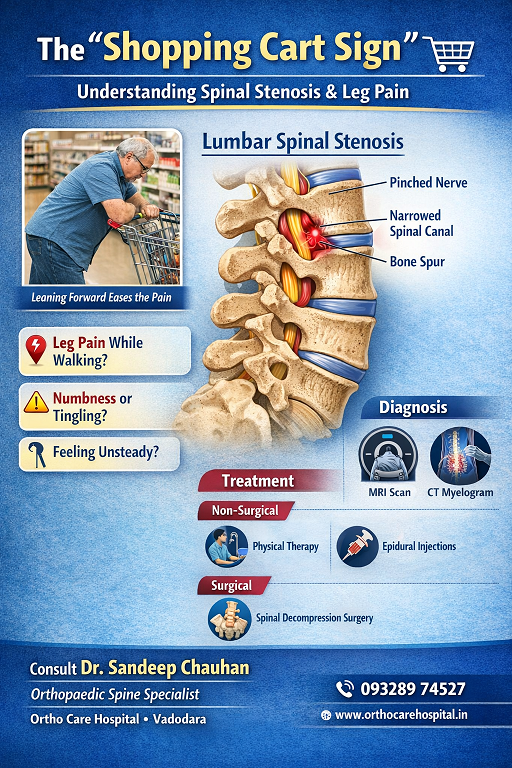
The “Shopping Cart Sign” Explained
The most fascinating (and diagnostic) aspect of Lumbar Spinal Stenosis is how the pain changes with your posture.
Why does leaning forward help?
When you stand up straight or walk, the natural curve of your lower back increases. This physical position actually narrows the spinal canal further, “pinching” the nerves and causing leg heaviness and cramping.
However, when you lean forward—such as when pushing a grocery cart—you are performing a “flexion” of the spine. This movement opens up the spinal canal, temporarily relieving the pressure on the nerves. If your leg pain disappears almost instantly when you sit down or lean forward, stenosis is the likely culprit.
Recognizing the Symptoms
Spinal stenosis symptoms often start as a dull ache and progress to more specific neurological issues:
- Neurogenic Claudication: This is the medical term for the cramping, pain, or tiredness in the legs that occurs when walking or standing but is relieved by sitting or leaning forward.
- Numbness or Tingling: A “pins and needles” sensation that starts in the buttocks and radiates down the legs.
- Weakness: In advanced cases, you may experience “foot drop,” where you have difficulty lifting the front part of your foot.
- Balance Issues: Because the nerves aren’t communicating correctly with the brain, your gait may become unsteady.
Diagnosis: Beyond the Physical Exam
At our Subhanpura clinic, Dr. Sandeep Chauhan performs a detailed neurological exam to check your reflexes, strength, and sensation. However, because stenosis is an internal structural issue, imaging is vital:
- MRI (Magnetic Resonance Imaging): This is the gold standard. It provides a detailed view of the nerves, discs, and ligaments, showing exactly where the “choking” of the nerves is occurring.
- CT Myelogram: If a patient cannot have an MRI (due to a pacemaker, etc.), a CT scan with contrast dye can highlight the pressure on the spinal cord.
Moving Toward Relief: Treatment Options
The goal of treatment at Ortho Care Hospital is to get you back to walking without the need for a grocery cart for support.
1. Conservative Management
Most patients begin with non-surgical options:
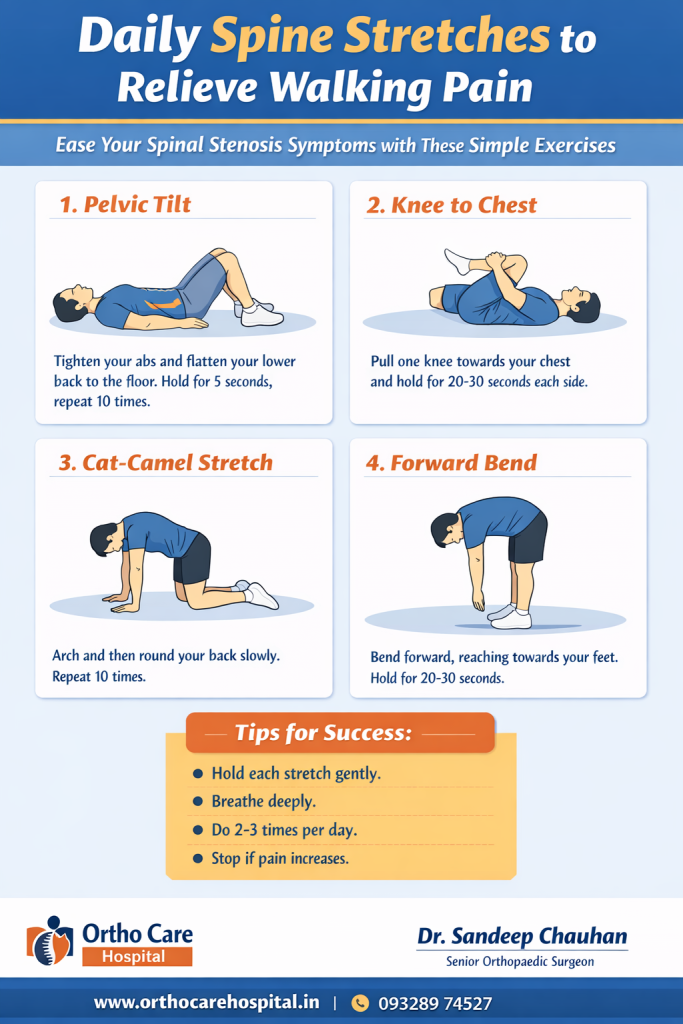
- Physical Therapy: Specialized exercises to strengthen the core and “flatten” the lower back curve can help open the spinal canal during movement.
- Epidural Steroid Injections: Guided injections can reduce inflammation around the pinched nerves, providing months of relief.
- Medication: Nerve-specific medications can help dampen the “cramping” and “burning” sensations.
2. Spinal Decompression Surgery
If conservative treatments fail and your quality of life is severely limited, surgery may be the best path forward.
- Laminectomy: This is the most common procedure. Dr. Chauhan removes the “roof” of the vertebrae (the lamina) to create more space for the nerves.
- Micro-Decompression: A minimally invasive approach using a microscope to remove only the specific bone spurs or thickened ligaments causing the blockage.
Reclaim Your Mobility
You shouldn’t have to plan your life around the nearest bench or grocery cart. Spinal stenosis is a treatable condition, and modern Spine Decompression techniques are safer and more effective than ever before.
Visit Ortho Care Hospital to discuss a personalized plan to strengthen your spine and stop the leg cramps.
Contact Us:
- Phone No: 093289 74527
- Address: 2nd Floor Sharnam Enclave, Above Kotak Bank, Subhanpura Main Road, New IPCL Road, Vadodara, 390023.