Because of the high amount of stress and strain an active lifestyle can put on your body, your bones and joints can be susceptible to injury. Common treatment includes arthroscopic surgery, as well as ligament and tendon repair or reconstruction and cartilage repair or restoration.
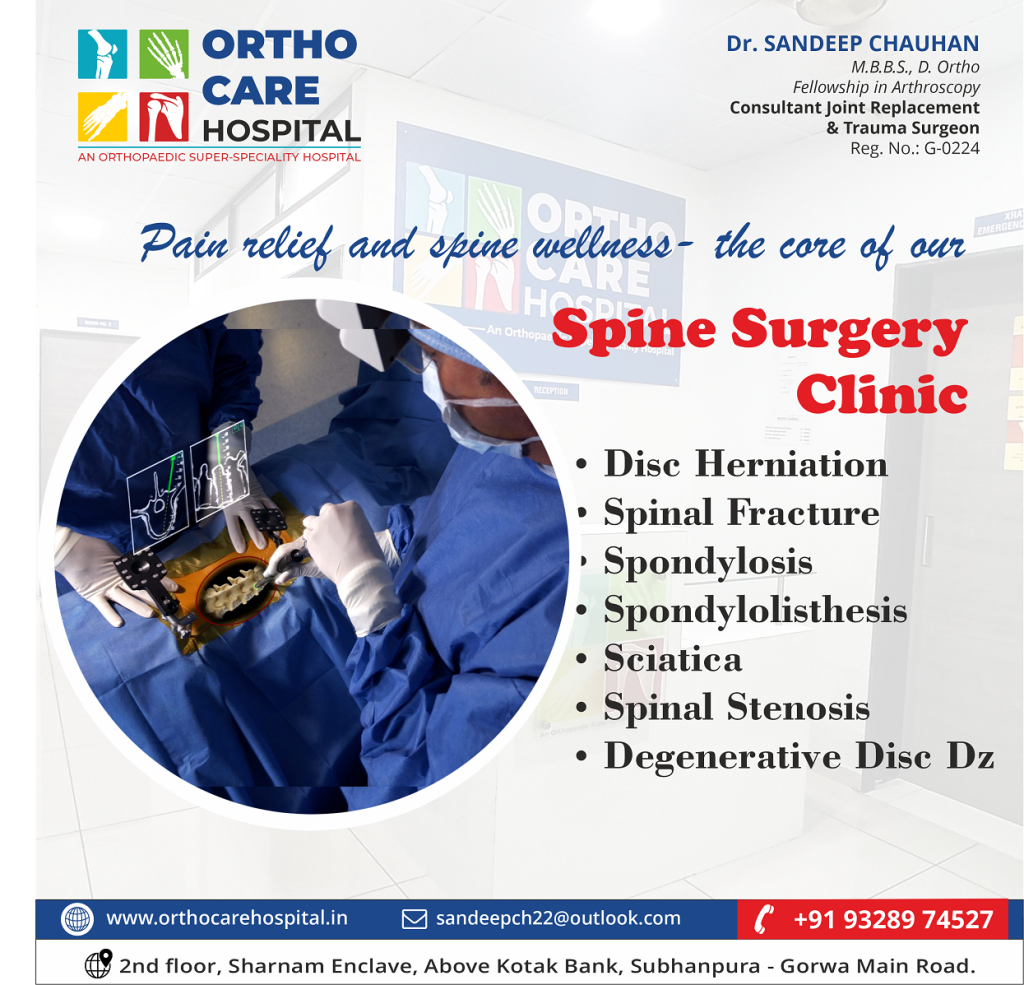
Understanding Spine Health: A Guide to Common Spinal Conditions
Back and neck pain can be more than just an inconvenience; they can fundamentally change how you live your life. At Ortho Care Hospital, recognized as a Top Orthopedic Hospital in Vadodara, our Spine Surgery Clinic is dedicated to diagnosing and treating complex spinal issues with a focus on long-term wellness and mobility.
Under the expert guidance of Dr. Sandeep Chauhan, we provide specialized care for a wide range of conditions. Here is a detailed look at the spinal issues we treat at our Subhanpura clinic.
1. Disc Herniation & Degenerative Disc Disease
Your spinal discs act as shock absorbers between your vertebrae. Over time, these discs can wear down (Degenerative Disc Disease) or the soft inner core can leak through a tear in the tough exterior (Disc Herniation).
- Symptoms: Sharp pain, numbness, or weakness that radiates into the arms or legs.
- The Care: We focus on modern decompression techniques to relieve pressure on the nerves and restore spinal cushioning.
2. Sciatica
Sciatica is not a disease itself, but a symptom of an underlying problem—usually a herniated disc or bone spur—compressing the sciatic nerve.
- Symptoms: A burning or searing pain that travels from the lower back through the hips and down each leg.
- The Goal: Identifying the root cause of the compression to provide immediate and lasting pain relief.
3. Spinal Stenosis
This condition involves the narrowing of the spaces within your spine, which puts pressure on the nerves that travel through it.
- Symptoms: Often develops gradually; you may feel tingling in the feet or difficulty walking long distances.
- Our Expertise: We offer surgical and non-surgical “unloading” procedures to create space for your nerves to function without pain.
4. Spondylosis & Spondylolisthesis
These terms sound similar but represent different challenges:
- Spondylosis: Age-related wear and tear of the spinal discs and joints (often called spinal osteoarthritis).
- Spondylolisthesis: Occurs when one vertebra slips forward over the one below it, often due to a small fracture or joint degeneration.
- The Approach: We focus on spinal stabilization to prevent further slippage and protect the spinal cord.
5. Spinal Fractures
Spinal fractures can result from high-impact trauma or osteoporosis. Unlike a broken arm, a broken vertebra can threaten your nervous system.
- Emergency Care: As a Top Orthopedic Hospital in Vadodara, we provide urgent surgical intervention to stabilize fractures and prevent permanent nerve damage.
Why Visit Ortho Care Hospital for Spine Care?
Choosing the Best Orthopedic Hospital in Vadodara near me means choosing a facility that understands the delicate nature of spine surgery.
- Expert Diagnosis: Led by Dr. Sandeep Chauhan, we ensure every treatment plan is individualized.
- Advanced Facilities: Our fully equipped operation theatre is designed for the high-precision machinery required for spine wellness.
- Holistic Recovery: We provide a positive environment for healing, including healthy, nutritious food at no extra cost for our inpatients.
Located at Subhanpura Main Road, we are here to help you rediscover a life without back pain.
Does every back pain issue require surgery?
No. At Ortho Care Hospital, surgery is always the last resort. Approximately 90% of spinal conditions improve with conservative care, such as physiotherapy, lifestyle modifications, and targeted injections. We only recommend surgery when non-surgical methods fail to provide relief or if there is a risk of nerve damage.
What are the common signs that I might need to see a spine specialist?
You should consult Dr. Sandeep Chauhan if you experience persistent back or neck pain that radiates into your arms or legs (Sciatica), numbness, tingling, or weakness in your limbs. Urgent consultation is required if you experience a loss of bladder or bowel control, as this can indicate serious nerve compression.
What is the difference between a slipped disc and a herniated disc?
These terms are often used interchangeably. A “slipped” or herniated disc occurs when the soft inner core of a spinal disc pushes through a tear in the outer layer. This can press on nearby nerves, causing the shooting pain known as Sciatica.
Is there a risk of paralysis during spine surgery?
This is a common fear, but the actual risk of permanent paralysis is extremely low (less than 0.5%). Modern techniques, specialized instrumentation, and the expertise of surgeons like Dr. Sandeep Chauhan have made spine surgery safer than ever before.
What is “Minimally Invasive” spine surgery?
Unlike traditional open surgery, minimally invasive techniques use smaller incisions and specialized tools to treat the spine with minimal muscle disruption. This results in less post-operative pain, a lower risk of infection, and a significantly faster return to your daily routine.
How long is the recovery period after spine surgery?
Recovery varies by procedure. For simple decompression or “keyhole” surgeries, patients can often return to light activity in 3 to 4 weeks. More complex procedures like spinal fusion may take 3 to 6 months for the bone to fully heal. We provide a detailed rehabilitation timeline for every patient.
When can I start walking after the operation?
“Motion is lotion.” We encourage most patients to stand and take short walks as early as the day after surgery. Early movement prevents stiffness and reduces the risk of blood clots. Our physiotherapy team will assist you in your first steps.
Will I need to wear a belt or brace after surgery?
In some cases, a back belt or brace is advised for a few weeks to provide support and limit “B.L.T.” (Bending, Lifting, Twisting) while the spine stabilizes. Your specific need for a brace will be discussed during your pre-operative consultation.
Can I drive after my spine surgery?
You can usually resume driving once you are no longer taking narcotic pain medications and have regained enough strength to perform an emergency brake. This typically takes 2 to 4 weeks, depending on the complexity of your surgery.
Will I have permanent restrictions on my lifestyle after spine surgery?
The ultimate goal of Dr. Sandeep Chauhan and the team at Ortho Care Hospital is to return you to your normal life, not to limit it. While you will have strict restrictions during the first 6–12 weeks (such as no heavy lifting, bending, or twisting), most patients eventually return to their favorite activities, including walking, swimming, and traveling.
For certain procedures like spinal fusion, we may advise against high-impact sports (like long-distance running or contact sports) to protect the levels of your spine above and below the surgery site. However, most patients find that the “restriction” of living without chronic pain is a far better lifestyle than the limitations they faced before surgery. At our Subhanpura clinic, we focus on Joint Preservation and core strengthening to ensure your results last for decades.