When most people hear the word “Scoliosis,” they immediately think of school-age screenings and teenagers in back braces. However, a significant number of adults in Vadodara are discovering that scoliosis is not exclusively a childhood condition. Whether it is a curve that has progressed since youth or a completely new development in later life, Adult Scoliosis is a leading cause of postural change, height loss, and chronic back pain.
At Ortho Care Hospital, we are seeing an increasing number of patients who walk into our clinic saying, “I’ve noticed one of my shoulders is higher than the other,” or “My clothes just don’t seem to hang straight anymore.” Under the expert guidance of Dr. Sandeep Chauhan, the Top Orthopaedic Doctor in Vadodara, we specialize in identifying these structural changes and providing a comprehensive approach to spinal health.
What is Adult Scoliosis?
Scoliosis is defined as an abnormal, sideways curvature of the spine. While a healthy spine has natural curves from front to back (neck and lower back), it should appear straight when viewed from behind. In an individual with scoliosis, the spine takes on a “C” or “S” shape.
In adults, this condition generally falls into two categories:
1. Adult Idiopathic Scoliosis
This occurs in patients who had scoliosis as children or teenagers. While the curve may have been small or stable during youth, the natural aging process, gravity, and the weakening of spinal ligaments can cause the curve to begin progressing again in adulthood.
2. Adult Degenerative Scoliosis (De Novo Scoliosis)
This is the “new” form of scoliosis that begins in adulthood, typically after age 50. It is not caused by a growth spurt, but by the “wear and tear” of the spine. As the intervertebral discs—the shock absorbers between your bones—begin to dry out and collapse unevenly, the spine can start to tilt and curve to one side.
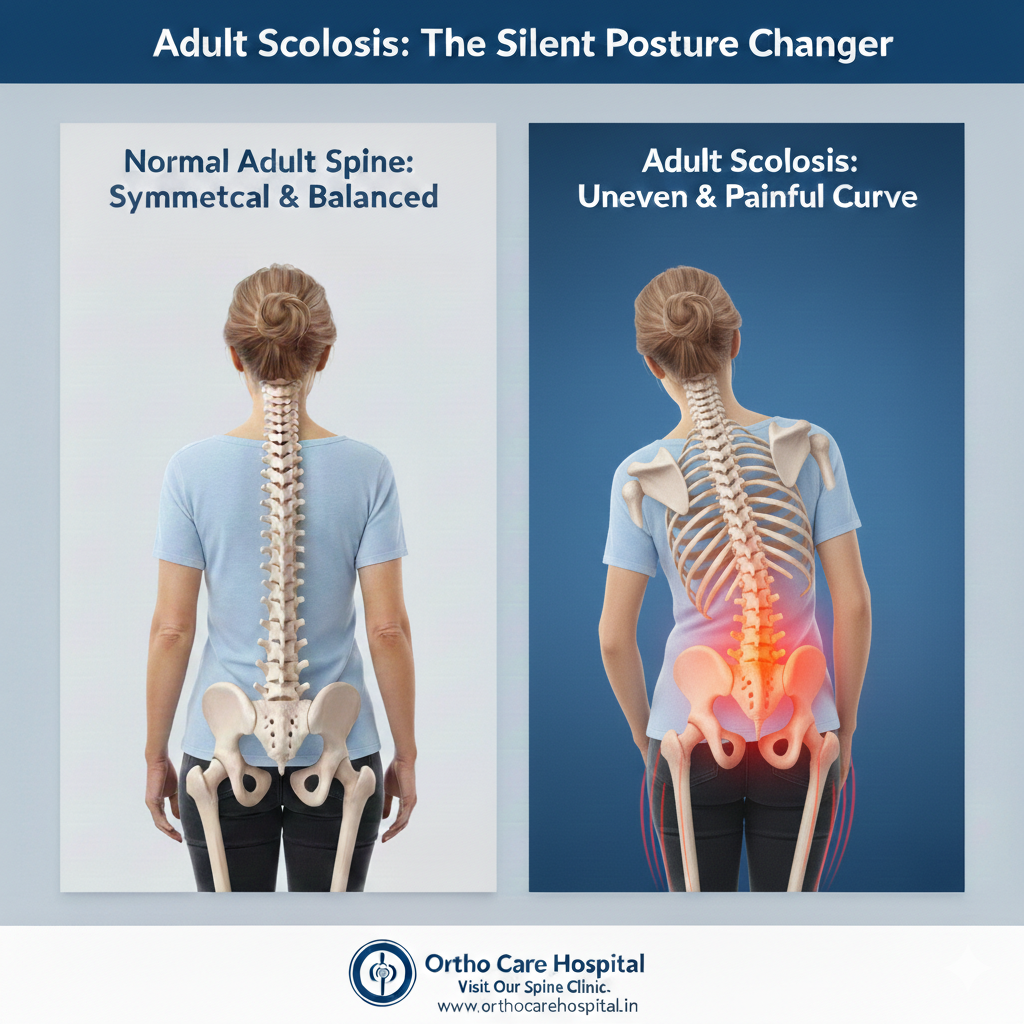
The Warning Signs: Why Your Posture is Shifting
Adult scoliosis is often a “hidden” condition because it progresses slowly. Patients often don’t realize their spine is curving until they see a change in their physical appearance or experience persistent pain.
Key symptoms to watch for include:
- Uneven Shoulders: One shoulder blade appears more prominent or sits higher than the other.
- Uneven Waistline: One hip may appear higher or “pushed out” to the side.
- Height Loss: A noticeable decrease in height as the spine compresses and curves.
- The “Forward Lean”: A tendency to lean forward or to one side to find a comfortable position.
- Radiating Pain: Unlike childhood scoliosis, which is rarely painful, adult scoliosis is often accompanied by back pain or leg pain (sciatica) caused by nerves being pinched within the curve.
The Science: Why Does the Spine Curve in Adulthood?
The primary driver of adult-onset scoliosis is Degenerative Disc Disease.
The spine is a delicate balance of bones, discs, and facet joints. If a disc on the left side of your lower back wears down faster than the one on the right, the spine will naturally begin to tilt toward the left. Over time, this tilt creates a “collapsing” effect. The muscles on one side of the spine have to work twice as hard to keep you upright, leading to chronic muscle fatigue, spasms, and the characteristic dull ache that many adults experience.
The Importance of Professional Screening
It is a common mistake to assume that a “stooped” posture or a “hunched” back is simply a natural part of aging. However, if back pain is accompanied by a visible curve or a change in how your clothes fit, a professional screening is essential.
At Ortho Care Hospital, the Best orthopaedic hospital in Vadodara, we use a combination of clinical exams and advanced diagnostics:
- The Adam’s Forward Bend Test: A simple but effective clinical move where the patient leans forward to reveal any rib humps or spinal rotation.
- Full-Length Spinal X-rays: These allow us to measure the Cobb Angle (the degree of the curve) and check for spinal balance.
- MRI/CT Scans: If you are experiencing leg numbness or weakness, we use these to see if the curve is compressing the spinal cord or nerve roots.
A Comprehensive Approach to Recovery
As the Best Orthopaedic doctor in Vadodara, Dr. Sandeep Chauhan prioritizes non-surgical treatments that focus on stability, pain management, and stopping the progression of the curve.
1. Specialized Physical Therapy
Generic exercises won’t work for scoliosis. We focus on “Schroth-based” principles—targeted exercises designed to strengthen the “weak” side of the curve and de-rotate the spine through specialized breathing and postural cues.
2. Core Strengthening
Building a “natural corset” of muscle around your spine helps take the pressure off the degenerated discs and joints, significantly reducing daily pain levels.
3. Pain Management
For patients with significant nerve pain, we may utilize localized injections or anti-inflammatory treatments to allow them to participate more effectively in physical therapy.
4. Bracing (In Specific Cases)
While braces don’t “fix” a curve in adults like they might in children, a specialized “adult scoliosis brace” can provide structural support and pain relief for those who stand for long periods.
Book Your Spinal Assessment Today
Your spine is the pillar of your mobility. Changes in your posture are your body’s way of signaling that this pillar needs support. Don’t wait for the curve to become severe or for the pain to become debilitating.
At our Subhanpura clinic, we provide the expert care and advanced technology needed to keep your spine healthy and your posture upright.
Contact Ortho Care Hospital:
- Phone No: 093289 74527
- Address: 2nd Floor, Sharnam Enclave, Above Kotak Bank, Subhanpura Main Road, New IPCL Road, Vadodara, 390023.