Some fractures do not need surgical intervention and can be treated with casting or bracing. However certain types of fracture are considered mal-aligned or unstable and may require surgical intervention. A thorough evaluation and an extensive discussion of treatment options, conservative and surgical will ensure optimal results.
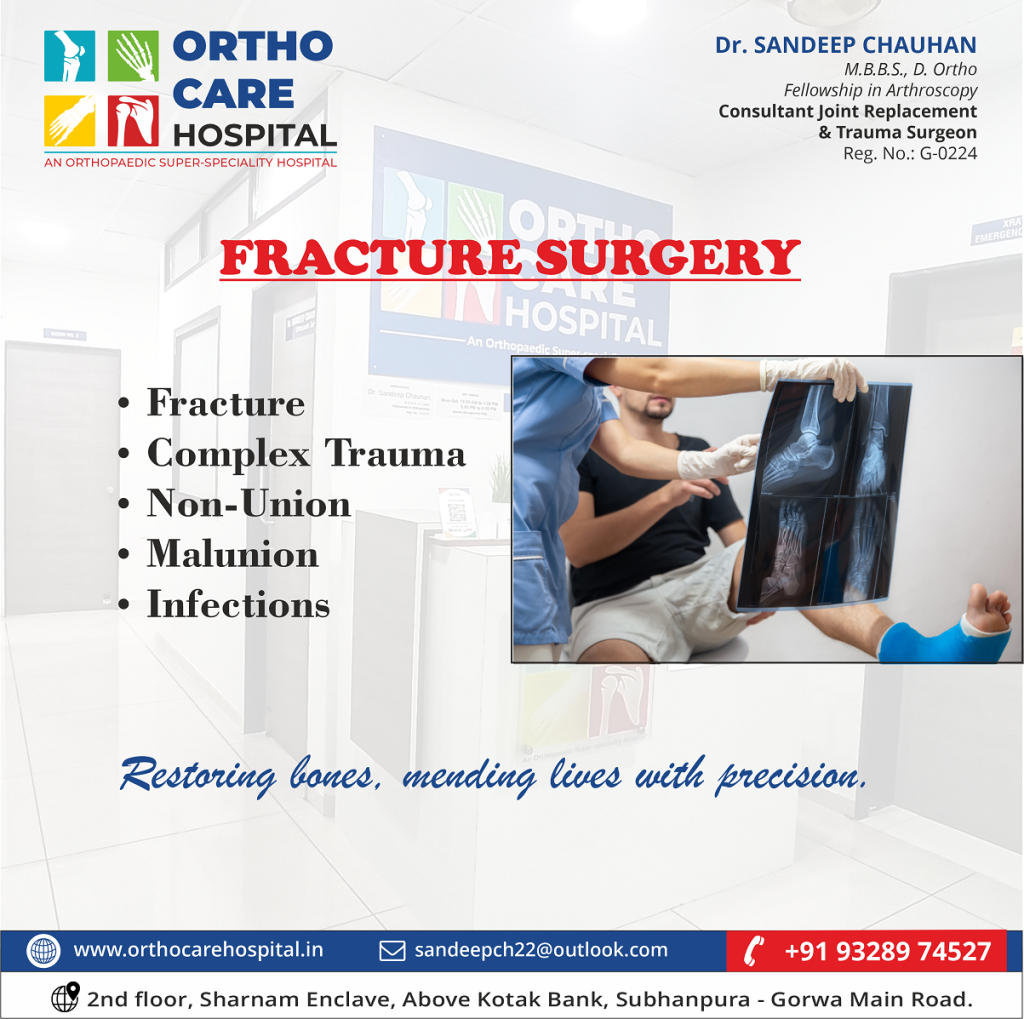
Restoring Bones, Mending Lives: A Guide to Advanced Fracture & Trauma Care
When a bone breaks, the impact goes beyond the physical injury—it disrupts your life. At Ortho Care Hospital, led by Dr. Sandeep Chauhan (M.B.B.S., D. Ortho, Fellowship in Arthroscopy), we specialize in the precision required to repair even the most challenging skeletal injuries.
If you are seeking a Top Orthopedic Doctor in Vadodara, understanding the complexities of bone healing is the first step toward a successful recovery. Here is a detailed look at the specialized trauma services we provide at our Subhanpura facility.
1. Acute Fracture Management
A fracture is more than just a “broken bone.” Whether it is a simple stress fracture or a severe displacement, immediate and accurate alignment is critical.
- Our Approach: Using high-frequency digital imaging, Dr. Chauhan ensures precise anatomical reduction to promote natural healing and prevent future joint wear.
2. Complex Trauma
High-impact accidents often result in complex trauma, involving multiple fractures or “shattered” bones (comminuted fractures).
- The Specialty: These cases require advanced fixation—using specialized plates, screws, or intramedullary nails—to stabilize the bone while protecting surrounding nerves and blood vessels. As a top orthopedic hospital in Vadodara, we are equipped to handle these high-stakes emergencies with surgical excellence.
3. Non-Union: When Bones Fail to Heal
A “Non-Union” occurs when a bone fails to show signs of healing after a significant period. This can be caused by poor blood supply, instability at the fracture site, or underlying health factors.
- The Solution: We utilize advanced intervention techniques, including bone grafting and specialized fixation adjustments, to “restart” the body’s natural healing process and finally bridge the gap.
4. Malunion: Correcting Improper Healing
If a fracture heals in an incorrect position—either rotated, bent, or shortened—it is called a Malunion. This can lead to chronic pain, visible deformity, and limited mobility.
- The Correction: Dr. Chauhan performs corrective osteotomies (surgically re-breaking and re-aligning the bone) to restore the limb’s natural function and appearance, ensuring you can move without restriction.
5. Orthopedic Infections (Osteomyelitis)
Bone infections are serious complications that can arise from open fractures or post-surgical issues. They require aggressive and specialized management.
- Our Comprehensive Care: Treatment involves meticulous “debridement” (cleaning the infected area), targeted antibiotic therapy, and often secondary surgeries to ensure the infection is completely eradicated before final bone stabilization.
Why Choose Ortho Care Hospital for Trauma?
When you are looking for the best orthopedic hospital in Vadodara near me, you need a facility that combines technology with dedicated post-operative support.
- Expertise: Directed by Dr. Sandeep Chauhan, a consultant Joint Replacement and Trauma Surgeon.
- Facility: Fully equipped operation theatre complex with the latest machinery.
- Patient-First Care: We provide a positive healing environment, including healthy, nutritious food at no extra cost for our inpatients to support bone regeneration.
Don’t let a fracture hold you back. Trust the experts at Ortho Care Hospital to get you back on your feet with precision and compassion.
What is the difference between a “fracture” and a “broken bone”?
In medical terms, there is no difference. A fracture is simply the clinical name for a broken bone. Whether it is a tiny “hairline” crack or a bone that has shattered into several pieces, all fractures require professional evaluation by a Top Orthopedic Doctor in Vadodara like Dr. Sandeep Chauhan to ensure they heal in the correct alignment.
Does every fracture require surgery?
Not necessarily. Many fractures can be treated with “closed reduction” (manually resetting the bone) and a cast or splint. Surgery is typically recommended for “displaced” fractures (where bones have shifted out of place), compound fractures (bone breaking the skin), or fractures involving a joint, which require plates and screws for stability.
How long does it take for a surgical fracture to heal?
While every patient is different, most bones take 6 to 12 weeks to heal significantly. However, complete remodeling of the bone—where it regains its full original strength—can take up to a year. At Ortho Care Hospital, we use high-frequency digital X-rays to monitor your “callus” formation (new bone growth) during your follow-up visits.
Will the metal plates and screws stay in my body forever?
In most adults, orthopedic hardware (plates, screws, and rods) is made of biocompatible titanium or stainless steel and is intended to stay in place permanently. Removal is only considered if the hardware causes irritation, becomes infected, or if the patient is a child whose bones are still growing.
When can I start putting weight on my injured leg?
“Weight-bearing” status is strictly determined by your surgeon based on the stability of the fix and the progress shown on your X-rays. Putting weight on a fracture too early can cause the metal hardware to bend or break. We will provide you with a clear timeline and coordinate with our on-site physiotherapy team to ensure a safe transition.
What is a “Non-Union,” and why does it happen?
A non-union occurs when a bone fails to heal. This can happen due to poor blood supply, excessive movement at the fracture site, or lifestyle factors like smoking and diabetes. As a specialized trauma center, we offer advanced “revision” surgeries and bone grafting to treat established non-unions.
How soon can I shower after fracture surgery?
You must keep your surgical incision and bandage completely dry until your sutures or staples are removed (usually 10 to 14 days after surgery). Once the wound is fully closed and cleared by Dr. Chauhan, you can typically return to normal showering, though soaking in a tub or pool is restricted for longer.
Is it normal to feel “clicking” or cold sensations at the injury site?
Yes. Mild clicking can occur as soft tissues move over the surgical hardware. Additionally, metal is a better conductor of temperature than bone, so some patients find that their surgical site feels “cold” or aches slightly during the winter months in Vadodara.
What are the warning signs of a post-surgical infection?
While our operation theatre complex follows strict sterility protocols, you should contact us immediately if you experience:
– Increasing redness or warmth around the incision.
– Persistent fever or chills.
– Foul-smelling drainage or pus from the wound.
– Pain that suddenly gets worse instead of better.
Can I speed up the bone-healing process?
Yes! Nutrition plays a vital role. A diet rich in Calcium, Vitamin D, and Protein provides the building blocks for new bone. To support this, Ortho Care Hospital provides healthy, nutritious meals at no extra cost for our inpatients. Additionally, avoiding smoking is the single most important lifestyle change you can make to ensure your bone heals quickly.