You are training for a marathon along the windy roads of Vadodara, or perhaps you have recently intensified your workout routine at the gym. Everything is going perfectly until you notice a persistent, nagging ache along the front or inside of your shinbone. At first, you dismiss it as simple “shin splints.” You push through the discomfort, believing in the old adage of “no pain, no gain.”
However, over the next few weeks, the pain changes. It stops being a generalized ache and becomes a highly localized, sharp point of tenderness. It begins to flare up earlier in your runs, eventually hurting even when you walk to your car. When you press directly on that specific spot on your shinbone, the sharp pinch makes you wince.
This is not a simple muscle strain or shin splints. It is very likely a Stress Fracture of the Tibia Shaft, frequently referred to as “the hidden break.”
At Ortho Care Hospital, we see an influx of local runners, athletes, and fitness enthusiasts dealing with this exact scenario. Under the medical leadership of Dr. Sandeep Chauhan, the Best Orthopaedic Surgeon in Vadodara, we specialize in diagnosing these microscopic bone injuries early. Using a comprehensive approach, our goal is to guide you safely back to peak performance before a tiny crack turns into a complete bone failure.
What is a Tibia Shaft Stress Fracture?
When most people think of a broken bone, they picture a traumatic event: a sudden fall, a vehicular accident, or a severe collision on the sports field that results in an immediate, agonizing snap. However, bones are dynamic, living tissues that can also break slowly over time due to repetitive, cumulative stress.
A stress fracture is a small, microscopic crack in the bone. The tibia (your shinbone) is the larger of the two bones in the lower leg and bears the vast majority of your body weight. The tibia shaft—the long, straight middle section of the bone—is under constant mechanical stress during weight-bearing activities like running, jumping, and dancing.
[Normal Healthy Bone Structure]
       ↓ (Repetitive Overuse / Insufficient Rest)
[Microscopic Bone Damage (Microdamage)]
       ↓ (Continued Stress outpaces Bone Repair)
[Stress Reaction / Bone Marrow Edema]
       ↓ (Final Structural Failure)
[Stress Fracture: A Microscopic Crack in the Tibia Shaft]
When repetitive forces are applied to the tibia without adequate time for recovery, the bone structure begins to fatigue, eventually leading to a structural micro-crack.
The Biology of Overuse: Why Do Stress Fractures Form?
To understand why a stress fracture develops, we must look at how bone responds to exercise. Your bones are constantly undergoing a natural, lifecycle process called remodeling. This process involves a balance between two types of specialized bone cells:
- Osteoclasts: Cells that break down older, fatigued bone tissue.
- Osteoblasts: Cells that lay down new, stronger bone mineral.
When you start a new running program or suddenly increase your workout intensity, the mechanical stress signals your body to remodel the tibia to make it stronger. First, the osteoclasts rush in to clear away the microscopic fatigue damage. This temporarily leaves the bone slightly weaker and more porous.
Under normal conditions, osteoblasts follow closely behind to rebuild the matrix. However, if you continue to hammer your legs with intense exercise day after day without sufficient rest, the osteoblasts cannot keep pace. The rate of bone breakdown outpaces the rate of bone formation. This structural imbalance creates a vulnerability, allowing a microscopic crack to manifest.
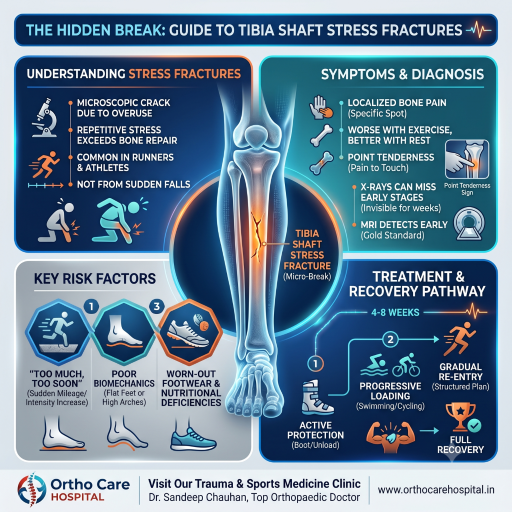
Are Your “Shin Splints” Actually a Stress Fracture?
One of the greatest challenges in patient education is helping athletes differentiate between Medial Tibial Stress Syndrome (MTSS)—commonly known as shin splints—and a true Tibia Stress Fracture. Pushing through shin splints is uncomfortable; pushing through a stress fracture can be catastrophic.
| Clinical Feature | Shin Splints (MTSS) | Tibia Stress Fracture |
| Type of Pain | A generalized, dull, aching pain along the inner edge of the lower shin. | A sharp, deep, highly localized pain on a specific spot on the shinbone. |
| Pain Behavior | Often hurts at the start of a workout, warms up/improves during exercise, but returns afterward. | Starts early in exercise, steadily worsens as you keep moving, and forces you to stop. |
| Rest Response | May feel stiff the next morning but eases with light movement. | Relieved by total rest; flares up immediately upon returning to weight-bearing activities. |
| Touch Sensitivity | Tenderness is spread out over a wide area (typically 4–6 centimeters) along the muscle-bone border. | Pinpoint tenderness. Pressing on one specific spot causes intense, sharp pain (Positive “Point Tenderness Sign”). |
| Night Pain | Rarely causes pain while sleeping or resting in bed. | Can cause a dull ache at night or when your legs are elevated. |
Primary Risk Factors for Local Runners and Athletes
Anyone can develop a stress fracture, but certain factors significantly increase your vulnerability. At our Subhanpura clinic, we analyze these risk factors to identify why the injury occurred in the first place:
1. The “Too Much, Too Soon” Rule
The single most common catalyst is a sudden change in physical activity. This includes abruptly increasing weekly running mileage, adding high-intensity interval training (HIIT) without a base, or transitioning to aggressive hill training before your muscles and bones adapt.
2. Poor Foot Mechanics and Biomechanics
The alignment of your feet dictates how shock waves travel up your lower leg.
- Overpronation (Flat Feet): Causes the foot to roll inward excessively, placing a twisting rotational force on the tibia shaft.
- High Arches (Rigid Feet): High arches absorb very little shock, transferring the raw impact of every stride directly up into the shinbone.
3. Impropoper Footwear and Hard Surfaces
Running in worn-out athletic shoes that have lost their shock-absorbing capabilities forces your bones to take the brunt of the impact force. Furthermore, consistently running on unforgiving concrete surfaces significantly increases the cumulative load on the lower limbs compared to dirt trails or synthetic tracks.
4. Nutritional Deficiencies and Metabolic Health
Your bones cannot rebuild without the proper raw materials. A deficiency in Vitamin D3 and Calcium severely cripples the ability of osteoblasts to calcify new bone tissue. Furthermore, low caloric availability relative to exercise output can disrupt hormonal balances, leading to decreased bone mineral density.
The Spectrum of Tibia Stress Fractures
Not all stress fractures carry the same level of risk. Orthopaedic specialists categorize tibia shaft stress fractures based on their anatomical location and structural severity:
Posteromedial Stress Fractures (Low Risk)
These occur on the back or inside edge of the shinbone. Because the surrounding calf muscles provide excellent blood supply and structural support, these fractures generally heal well with conservative, non-surgical treatment.
Anterior Cortex Stress Fractures (High Risk)
These occur on the front, outer edge of the shinbone. This area is under constant tension forces when you walk or run. Because the front of the shin has a limited blood supply and is constantly being pulled apart mechanically, these fractures have a notorious reputation for failing to heal on their own (non-union) and can progress to a complete displacement.
How We Diagnose the “Hidden Break”
If you suspect a stress fracture, scheduling a professional evaluation is essential. At Ortho Care Hospital, Dr. Sandeep Chauhan employs an exact clinical protocol to confirm the diagnosis:
The Clinical Examination
- The Hop Test: If you cannot hop on your single affected leg for 3 to 5 consecutive bounds without intense pain, it heavily points toward a structural bone injury rather than a muscular strain.
- The Tuning Fork Test: Placing a vibrating tuning fork against the tibia can elicit localized pain if a micro-fracture is present.
Advanced Diagnostics
- The X-Ray Illusion: It is a common misconception that a normal X-ray rules out a stress fracture. In the first 3 to 4 weeks of a stress injury, a tiny crack is virtually invisible on standard X-rays. X-rays only reveal the injury after the bone begins to heal, showing a faint white line of new bone formation (callus).
- MRI (The Gold Standard): An MRI is highly accurate. It detects the very earliest signs of a stress injury—such as bone marrow edema (swelling inside the bone)—long before a physical crack even materializes.
A Comprehensive Approach to Healing
Recovering from a tibia stress fracture requires patience and a structured, multi-phase plan. At our Subhanpura facility, we don’t just tell you to sit on the couch; we provide a dynamic recovery pathway:
[Phase 1: Active Protection] ➔ [Phase 2: Progressive Loading] ➔ [Phase 3: Re-Entry & Prevention]
• Non-weight bearing/Boot      • Low-impact cross-training      • Structured running plan
• Pain elimination             • Strength restoration            • Biomechanical correction
Phase 1: Active Protection and Unloading
The primary objective is to stop the mechanical stress causing the micro-damage. Depending on the severity of your localized pain, this may involve wearing a walking boot for 4 to 6 weeks to redistribute weight-bearing loads away from the tibia shaft. Complete rest from running is non-negotiable.
Phase 2: Cross-Training and Strength Restoration
To maintain your cardiovascular fitness without stressing the tibia, we introduce non-weight-bearing activities:
- Swimming and Deep-Water Running: Provides excellent cardiovascular conditioning with zero impact forces.
- Stationary Cycling: Low-resistance cycling helps maintain leg muscle tone without putting repetitive vertical impacts through the shinbone.
- Targeted Physical Therapy: We focus heavily on strengthening the calf muscles, gluteus medius, and core. Stronger muscles act as natural shock absorbers, deflecting impact forces away from your skeletal frame.
Phase 3: Structural Re-Entry and Running Progression
Once you can walk for 30 consecutive minutes completely pain-free and display no tenderness upon direct palpation, Dr. Chauhan will design a structured, gradual return-to-run program. This usually begins with an alternating walk-to-run progression (e.g., 1 minute of light jogging followed by 4 minutes of walking) performed on alternate days to monitor how the bone responds.
When is Advanced Intervention Required?
While the majority of posteromedial tibia stress fractures heal with strict conservative care, certain high-risk fractures (like anterior cortex cracks) or chronic non-union cases require advanced treatment:
- Bone Stimulators: A non-invasive device that uses electromagnetic fields or low-intensity pulsed ultrasound (LIPUS) to biologically trigger osteoblasts to repair stubborn bone voids.
- Surgical Stabilization: In rare instances where an anterior stress fracture shows signs of widening or failing to heal, surgery may be necessary. This typically involves Intramedullary Nailing, where a specialized titanium rod is inserted down the center of the tibia canal to permanently stabilize the bone from the inside out.
Learn About Spine and Lower Limb Alignment Today
Do not allow a microscopic crack to derail your long-term fitness goals. If you have been ignoring localized shin pain, remember that structural bone tissue does not heal by simply running through the discomfort.
At Ortho Care Hospital, we focus on a complete approach to sports medicine—diagnosing the underlying biomechanical flaws, fixing nutritional gaps, and providing an expert roadmap back to full function.
Take control of your structural health and protect your legs by booking a comprehensive assessment today.
Connect with Ortho Care Hospital:
- Website: www.orthocarehospital.in
- Phone No: 093289 74527
- Address: 2nd Floor Sharnam Enclave, Above Kotak Bank, Subhanpura Main Road, New IPCL Road, Vadodara, 390023.