It often starts with a curious discovery: you’re leaning on your desk or propping yourself up in bed when you notice a soft, squishy, or protruding lump on the very tip of your elbow. It might look like a “goose egg” or a small water balloon trapped under the skin.
In medical terms, this is known as Olecranon Bursitis, but it is more commonly referred to as “Student’s Elbow,” “Plumber’s Elbow,” or “Baker’s Elbow.” While often painless in the early stages, ignoring this swelling can lead to severe complications, including acute infection.
At Ortho Care Hospital, we see many patients in Vadodara who wait until the lump is red and throbbing before seeking help. Under the guidance of Dr. Sandeep Chauhan, the Best Orthopaedic Doctor in Vadodara, we advocate for early assessment to prevent the need for more invasive procedures.
What is a Bursa and Why is it Swollen?
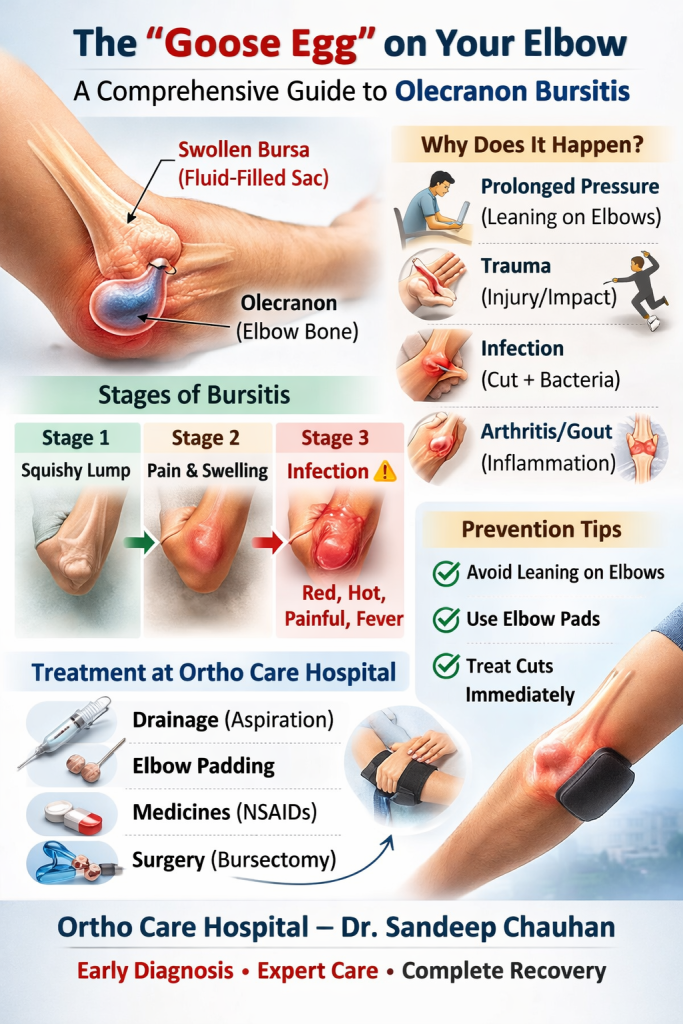
To understand bursitis, you first need to understand the Bursa. A bursa is a thin, slippery, fluid-filled sac that acts as a cushion between bones and soft tissues (like skin or tendons). Its job is to reduce friction during movement.
The Olecranon Bursa sits right between the pointy bone of your elbow (the olecranon) and the overlying skin. Normally, this sac is flat and contains very little fluid. However, when it becomes irritated or inflamed, it fills with excess fluid, creating the characteristic “goose egg” appearance.
Why Does It Happen? (Common Causes)
Olecranon Bursitis can be triggered by several factors, ranging from lifestyle habits to sudden trauma:
- Prolonged Pressure (The Most Common Cause): Repeatedly leaning on your elbows on hard surfaces—such as a desk, a workbench, or even the floor—irritates the bursa over time. This is why it’s frequently seen in students, plumbers, and technicians.
- Trauma: A sharp blow to the tip of the elbow (like a fall or hitting it against a doorway) can cause the bursa to swell immediately as it fills with fluid or blood.
- Infection (Septic Bursitis): If you have a small cut, scrape, or even an insect bite on your elbow, bacteria can enter the bursa. This is a medical emergency that requires prompt antibiotic treatment.
- Underlying Medical Conditions: Patients with gout, rheumatoid arthritis, or kidney issues are more prone to developing bursitis due to crystal deposits or systemic inflammation.
The Three Stages of Symptoms
Bursitis doesn’t always hurt right away, which is why many patients delay their visit to our Subhanpura clinic.
- Stage 1: The “Squishy” Lump. The first sign is swelling. At this stage, it often feels like a soft bag of fluid. You may still have a full range of motion in your elbow.
- Stage 2: Inflammation and Tenderness. As the bursa continues to expand, it can become tender to the touch. Putting your elbow down on a table becomes uncomfortable, and the skin may feel slightly warm.
- Stage 3: Infection (Septic Bursitis). This is the most dangerous stage. The elbow becomes bright red, very hot, and extremely painful. You may develop a fever or chills. If you experience these symptoms, you must seek medical attention immediately.
A Comprehensive Approach to Treatment
At Ortho Care Hospital, Dr. Sandeep Chauhan utilizes a tailored approach to treat elbow bursitis, focusing on reducing swelling and preventing recurrence.
Non-Surgical Management
- Aspiration (Drainage): If the swelling is large or causing significant discomfort, Dr. Chauhan may use a sterile needle to drain the fluid. This provides immediate relief and allows us to test the fluid for infection.
- Elbow Padding: Simple “doughnut” pads can protect the area from further pressure while it heals.
- Activity Modification: Identifying and stopping the repetitive leaning that caused the issue.
- Medication: Non-steroidal anti-inflammatory drugs (NSAIDs) are used to manage pain and reduce the internal swelling of the sac.
When is Surgery Necessary?
If the bursitis becomes chronic (constantly returning) or if an infection does not respond to antibiotics, Bursectomy may be required. This is a surgical procedure to remove the entire bursa sac. Because the bursa is outside the joint, this surgery typically does not affect the movement of the elbow itself.
Don’t Let the “Goose Egg” Grow
While a small lump might seem like a minor nuisance, the risk of infection makes Olecranon Bursitis something that should never be ignored. Whether you need a diagnostic aspiration or a professional management plan, our team at Ortho Care Hospital is here to ensure your recovery is swift and complete.
Get Your Elbow Checked Today:
- Phone No: 093289 74527
- Address: 2nd Floor Sharnam Enclave, Above Kotak Bank, Subhanpura Main Road, New IPCL Road, Vadodara, 390023.