Have you ever been walking on a perfectly flat surface, only to feel your ankle suddenly “give way” or buckle beneath you? If you find yourself constantly scanning the ground for uneven pavement or if you’ve lost count of how many times you’ve “rolled” your ankle, you aren’t just clumsy. You are likely dealing with Chronic Ankle Instability (CAI).
At Ortho Care Hospital, we see many patients in Vadodara who have accepted a “wobbly” ankle as a normal part of their lives. However, repeated “giving way” is a sign that the structural integrity of your joint is compromised. Under the expertise of Dr. Sandeep Chauhan, the Best Orthopaedic Doctor in Vadodara, we specialize in moving patients from constant instability to confident movement.
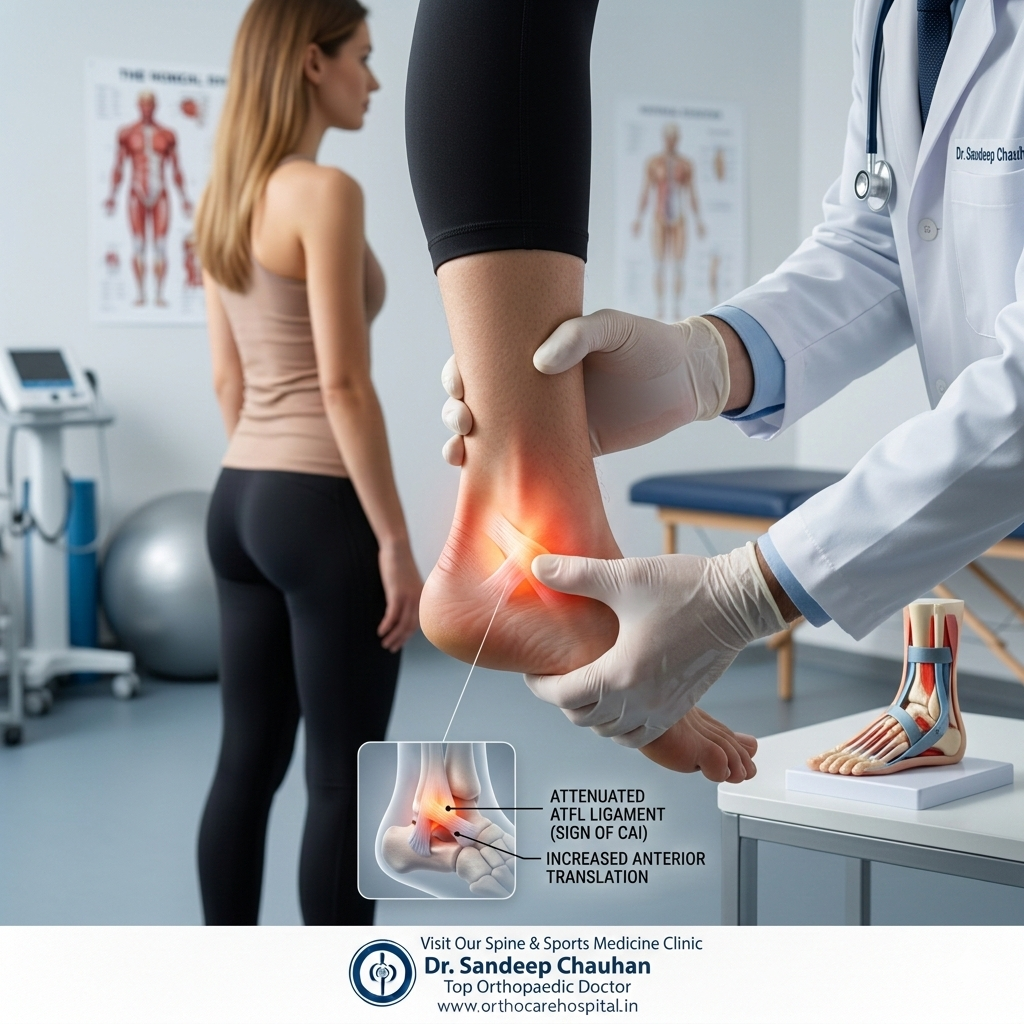
The Cycle of the Sprain: How Instability Develops
Most cases of chronic instability begin with a single, poorly healed ankle sprain.
When you sprain your ankle (usually an “inversion” sprain where the foot turns inward), the ligaments on the outside of the ankle—specifically the Anterior Talofibular Ligament (ATFL)—are stretched or torn.
The Path to Chronic Instability:
- The Initial Injury: A significant sprain occurs.
- Inadequate Rehabilitation: The pain goes away, so the patient stops doing their exercises.
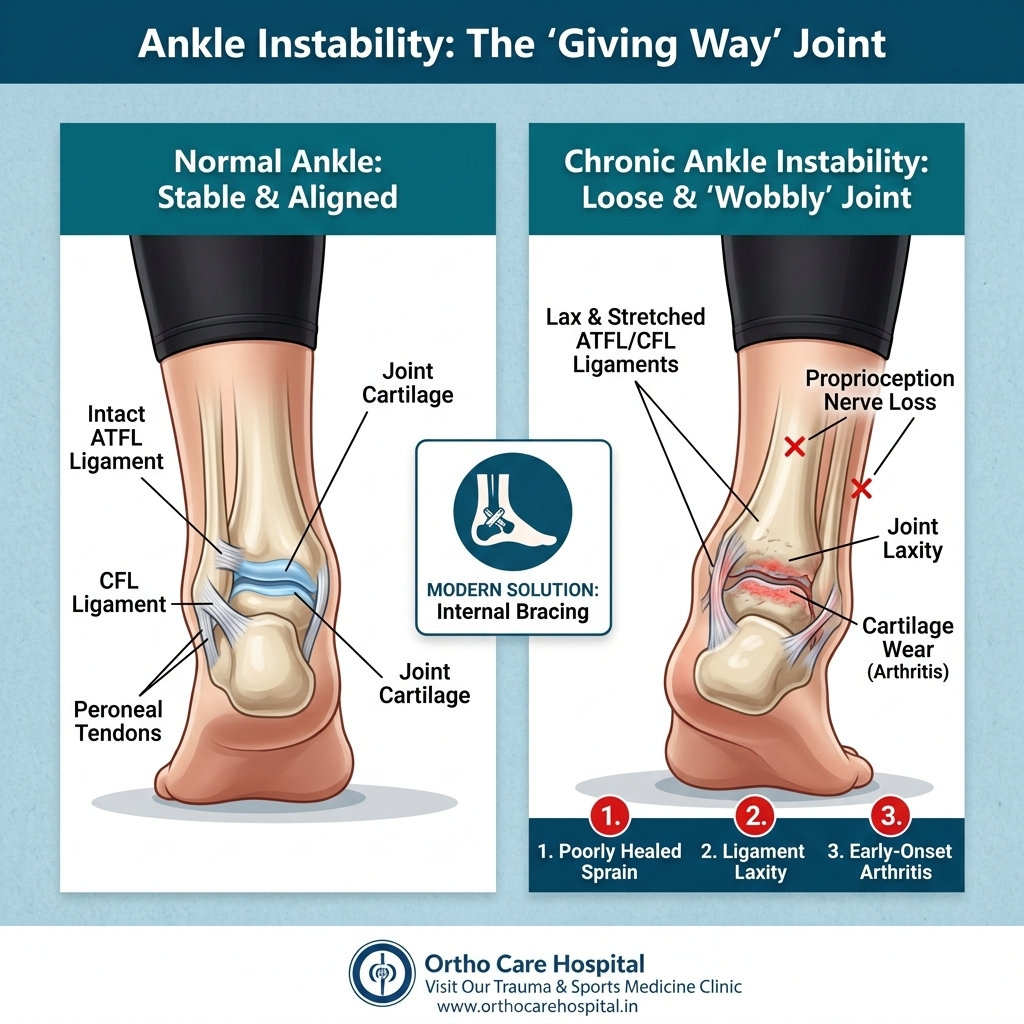
- Ligament Laxity: The ligaments heal in a “stretched-out” or loose position.
- Proprioception Loss: The nerve endings in the ligaments that tell your brain where your foot is in space (balance) are damaged.
- The “Giving Way” Phenomenon: Because the mechanical support is loose and the “balance sensors” are offline, the ankle becomes prone to repeated rolling, even during simple activities.
Recognizing the Symptoms of CAI
Chronic Ankle Instability isn’t just about the moments the ankle actually rolls. It presents a daily set of symptoms:
- Persistent Tenderness: A dull ache on the outer side of the ankle.
- Chronic Swelling: The ankle always looks slightly “puffy” compared to the other side.
- The “Wobbly” Feeling: A constant sense of insecurity or lack of trust in the joint.
- Frequent Rolling: Spraining the ankle during low-impact activities like walking on grass or stepping off a curb.
The Hidden Danger: Long-Term Consequences
Many patients ask, “If I can live with the occasional roll, why treat it?” The answer lies in the cartilage. Every time your ankle “gives way,” the bones (the talus and the tibia/fibula) can knock against each other. This “micro-trauma” eventually wears down the smooth joint cartilage, leading to early-onset Ankle Arthritis. Once the cartilage is gone, the pain becomes permanent and much harder to treat.
The Comprehensive Approach to Recovery
At Ortho Care Hospital, our goal is to restore the “internal seatbelt” of your ankle. We categorize treatment into two main phases:
1. Specialized Rehabilitation (Non-Surgical)
Before considering surgery, we focus on Proprioceptive Training. We use balance boards and specific agility drills to “re-train” the brain to catch the ankle before it rolls. Strengthening the Peroneal Muscles (the muscles on the side of your leg) is also vital, as they act as dynamic stabilizers that pull the ankle back into place.
2. Modern Surgical Solutions: The “Internal Brace”
For patients whose ligaments are too stretched to be fixed by exercise alone, Dr. Sandeep Chauhan utilizes advanced surgical techniques like Anatomical Ligament Reconstruction with Internal Bracing.
- What is Internal Bracing? Instead of just stitching the old, weak ligaments back together, we reinforce the repair with a high-strength medical tape (FiberTape).
- The Benefit: This “internal seatbelt” protects the repaired ligament while it heals, allowing for much faster rehabilitation and a significantly lower risk of the ankle ever giving way again.
Strengthen Your Ankles Today
You don’t have to live your life looking at your feet. Whether you need a specialized physiotherapy program or a modern surgical stabilization, our Trauma and Sports Medicine clinic is equipped to help.
Take the first step toward stability and prevent long-term joint damage by booking a professional assessment with Dr. Sandeep Chauhan.
Contact Ortho Care Hospital:
- Phone No: 093289 74527
- Address: 2nd Floor Sharnam Enclave, Above Kotak Bank, Subhanpura Main Road, New IPCL Road, Vadodara, 390023.