Have you ever looked down at your wrist and noticed a sudden, firm lump that wasn’t there yesterday? If your first instinct was to panic, you aren’t alone. These “mysterious” lumps are one of the most common reasons patients visit Ortho Care Hospital in Vadodara.
Most often, this lump is a Ganglion Cyst. While the appearance of a sudden growth can be alarming, the good news is that these cysts are entirely benign (non-cancerous). However, their location near joints and tendons can cause discomfort, weakness, and restricted movement.
Under the clinical leadership of Dr. Sandeep Chauhan, the Best Orthopaedic Doctor in Vadodara, we specialize in the diagnosis and “no-book” treatment of these common hand conditions.
What Exactly is a Ganglion Cyst?
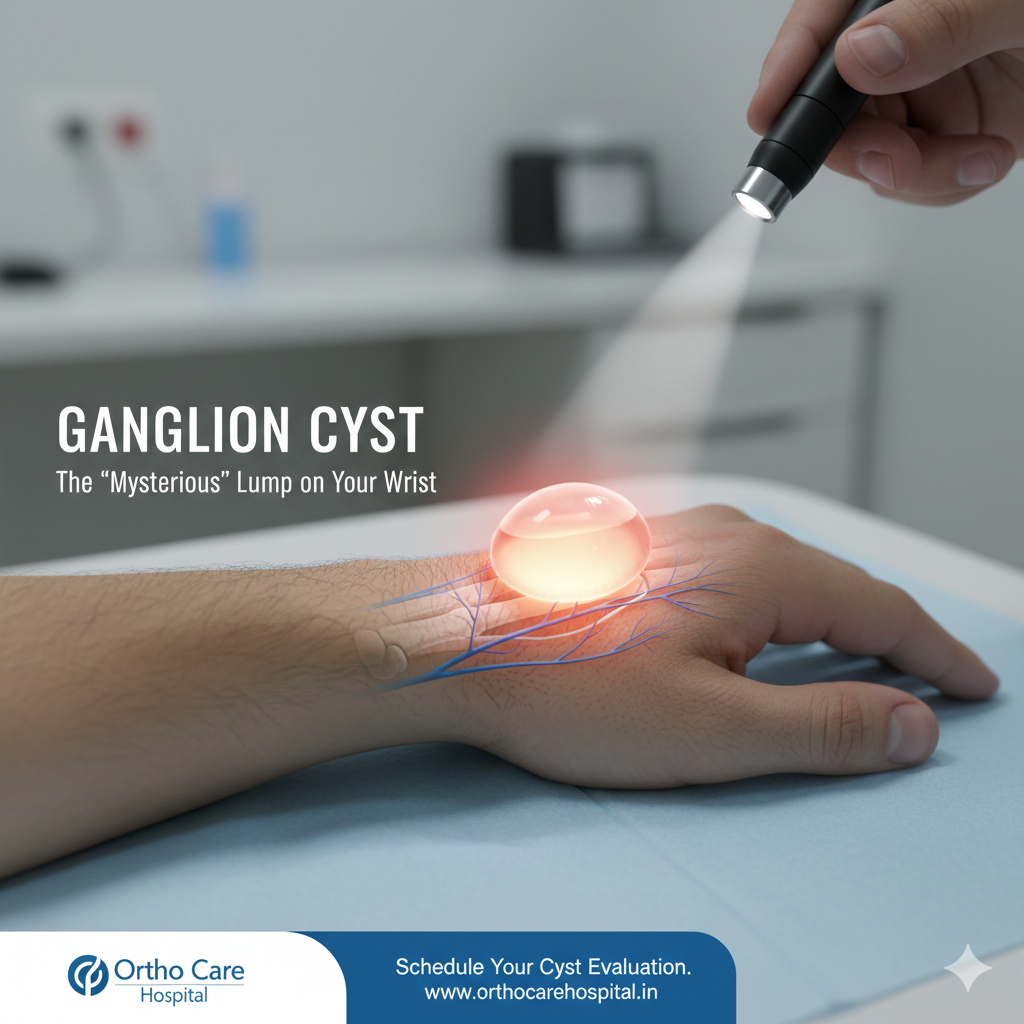
A ganglion cyst is a fluid-filled sac that typically develops along the joints or tendons of the wrists or hands. Think of it like a small water balloon on a stalk. They are filled with a thick, clear, jelly-like fluid—similar to the synovial fluid that lubricates your joints.
Common Locations:
- The Back of the Wrist (Dorsal): The most frequent site.
- The Palm Side of the Wrist (Volar): Often near the thumb side.
- The Base of the Finger: Usually on the palm side, appearing as a small, pea-sized bump.
- The End Joint of the Finger: Often associated with arthritis in older adults.
Recognizing the Symptoms
Ganglion cysts are unique because they can change in size. They may grow larger with increased activity and shrink when the joint is rested.
- The Appearance: A round or oval lump that is usually firm, but may feel slightly soft.
- Pain: Many cysts are painless. However, if the cyst is positioned in a way that it presses on a nerve, it can cause a dull ache, tingling, or muscle weakness.
- Size: They can range from the size of a pea to an inch in diameter. Some are “occult,” meaning they are hidden under the skin and can only be detected via ultrasound or MRI.
Why Do They Form?
The exact cause of a ganglion cyst is still a subject of medical debate, but the most widely accepted theory is the “Leakage Theory.” It is believed that joint or tendon sheath tissue undergoes a degenerative change, allowing the lubricating fluid to leak out and form a sac.
Risk Factors include:
- Age and Sex: They are most common in women between the ages of 20 and 40.
- Joint Overuse: Repetitive stress on the wrist (common in gymnasts, weightlifters, or heavy computer users) can trigger their development.
- Previous Injury: An old wrist sprain or joint injury can predispose you to a cyst later in life.
The “Bible Bump” Myth: Why Home Remedies are Dangerous
In the past, ganglion cysts were nicknamed “Bible Bumps.” This is because a common historical “home remedy” involved hitting the cyst with a heavy book—like a family Bible—to rupture the sac and make the lump disappear.
Dr. Sandeep Chauhan and the team at Ortho Care Hospital strongly advise against this.
Hitting a cyst with a heavy object can cause:
- Fractures: You could easily break the small bones in your wrist.
- Skin Damage: Severe bruising and tissue damage.
- Infection: If the skin breaks, bacteria can enter the joint.
- High Recurrence: Even if the cyst “pops,” the stalk remains, and the cyst will likely return within weeks.
Professional Diagnosis and Treatment
At our Subhanpura clinic, we provide a comprehensive approach to hand and wrist care.
1. Diagnosis
Dr. Chauhan will perform a “Transillumination Test.” By shining a light through the lump in a darkened room, he can determine if it is filled with clear fluid (indicating a cyst) or if it is a solid mass. If the diagnosis is unclear, an Ultrasound or MRI may be ordered.
2. Observation
If the cyst is not painful and does not interfere with function, the best treatment is often “watchful waiting.” Many ganglion cysts disappear on their own over time.
3. Aspiration
For cysts that cause pain or limit movement, we perform a professional aspiration.
- The Process: The area is numbed, and a needle is used to drain the thick fluid from the sac.
- The Benefit: Immediate relief of pressure and disappearance of the lump.
4. Surgical Removal (Excision)
If the cyst returns after aspiration or is located in a position that threatens a nerve, surgery may be the best option. This involves removing the cyst sac along with its “stalk” to minimize the chance of it ever returning.
Schedule Your Cyst Evaluation
Don’t let a mysterious lump cause you unnecessary anxiety. Whether you need a simple diagnosis or a professional aspiration, the experts at Ortho Care Hospital are here to help. We provide the highest standard of orthopaedic care in Vadodara, ensuring your hands stay healthy and functional.
Get in touch with us:
- Phone No: 093289 74527
- Address: 2nd Floor Sharnam Enclave, Above Kotak Bank, Subhanpura Main Road, New IPCL Road, Vadodara, 390023.