Lower back pain is one of the most common reasons patients walk through the doors of Ortho Care Hospital. Often, people assume their discomfort is just a pulled muscle or a “slipped disc.” But what happens when the pain feels deeper, more structural, and specifically worsens when you arch your back or lean backward?
You might be experiencing Spondylolisthesis. This condition, while common, requires a specialized diagnostic approach to prevent long-term nerve damage. Under the expert guidance of Dr. Sandeep Chauhan, the Top Orthopaedic Doctor in Vadodara, our spine clinic is dedicated to helping patients understand the difference between a simple ache and a structural slip.
What is Spondylolisthesis?
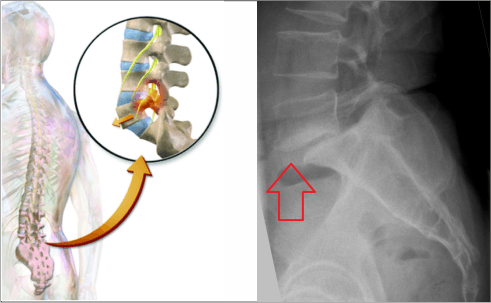
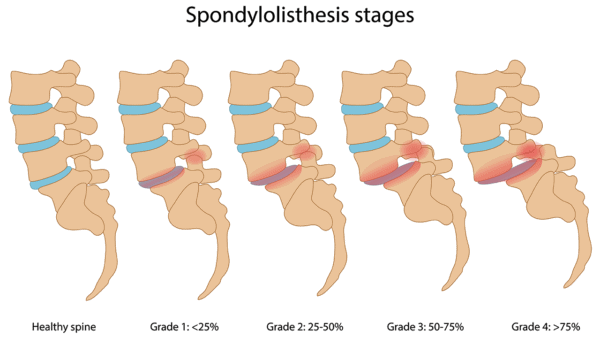
The word might be a mouthful, but the concept is straightforward: it refers to the forward slippage of one vertebra over the one below it.
Your spine is a precise stack of bones (vertebrae) held together by joints, ligaments, and discs. In a healthy spine, these bones align perfectly to protect the spinal cord. In Spondylolisthesis, a structural weakness or injury causes a vertebra to lose its “grip” and slide forward.
How It Differs from a Disc Bulge
Many patients use the terms “slipped disc” and “slipped bone” interchangeably, but they are very different:
- Disc Bulge/Herniation: This involves the soft, jelly-like cushion between the bones pushing out. The bones themselves stay in place.
- Spondylolisthesis: This is a bone-on-bone structural shift. Because the bone moves, it can narrow the space available for nerves, leading to both mechanical back pain and radiating nerve pain.
Why Does It Hurt More When You Lean Backward?
The “hallmark” symptom of Spondylolisthesis is pain that intensifies during extension (leaning backward).
When you lean back, you increase the pressure on the posterior elements of your spine. If a vertebra is already unstable and slipped forward, this movement “pinches” the structures even further. Conversely, many patients find relief when sitting or leaning forward (flexion), as this opens up the spinal canal.
Other Common Symptoms Include:
- Persistent ache in the lower back (lumbar region).
- Tightness in the hamstrings (a very common sign in younger patients).
- Pain that radiates into the buttocks or thighs (sciatica).
- A “step-off” feeling—a noticeable bump in the spine that you can feel with your fingers.
The Different Types: Why Did This Happen?
Spondylolisthesis isn’t a “one size fits all” condition. At Ortho Care Hospital, the Best orthopaedic hospital in Vadodara, we categorize the slip to determine the best treatment:
- Degenerative Spondylolisthesis: The most common type in older adults. As we age, the discs and joints (facet joints) wear down, allowing the bone to slide.
- Isthmic Spondylolisthesis: Resulting from a small stress fracture in a piece of bone called the pars interarticularis. This is common in athletes who perform repetitive back-bending, like gymnasts or cricketers.
- Congenital (Dysplastic): Present from birth due to a malformed spine.
- Traumatic: Caused by a sudden, high-impact injury that breaks the spinal supports.
The Importance of Specialized Imaging
You cannot diagnose Spondylolisthesis through a physical exam alone. Because it is a structural shift, specialized imaging is mandatory.
- X-Rays (Flexion/Extension): We often take X-rays while you are bending forward and backward. This shows us if the vertebra is “unstable” and moving more than it should.
- MRI: Essential for seeing if the slipped bone is compressing the spinal nerves or the thecal sac.
- CT Scans: Best for looking at the bony architecture to see if a stress fracture is present.
As the Best Orthopaedic doctor in Vadodara, Dr. Sandeep Chauhan utilizes these diagnostics to “grade” the slip—from Grade I (minimal slip) to Grade IV (severe slip).
Comprehensive Recovery at Our Spine Clinic
The goal of our Spine Clinic at Ortho Care Hospital is to restore stability. Our comprehensive approach means we rarely jump to surgery as the first option.
Conservative Management
- Core Stabilization: We focus on “internal bracing.” Strengthening the deep abdominal and back muscles helps hold the spine in place.
- Activity Modification: Avoiding high-impact sports and repetitive hyperextension.
- Bracing: In acute cases, a back brace can help stabilize the segment and allow inflammation to subside.
Advanced Interventions
If conservative care fails or if there is significant nerve weakness, Dr. Chauhan may discuss:
- Nerve Block Injections: To reduce localized inflammation.
- Spinal Fusion: A surgical procedure to “weld” the unstable bones together, preventing further slippage and protecting the nerves.
Visit Our Spine Clinic Today
Chronic back pain shouldn’t be your “normal.” If you feel a catch in your back when you stand up straight or lean back, it’s time for a professional evaluation.
At Ortho Care Hospital, we combine the expertise of Dr. Sandeep Chauhan with state-of-the-art diagnostics to give you a clear path to recovery.
Contact Us:
- Phone No: 093289 74527
- Address: 2nd Floor Sharnam Enclave, Above Kotak Bank, Subhanpura Main Road, New IPCL Road, Vadodara, 390023.