Have you ever stopped mid-walk to shake out your shoe, certain that a small stone or a fold in your sock is causing discomfort, only to find absolutely nothing there? If you experience a persistent sensation of standing on a pebble, or a burning pain in the ball of your foot that radiates toward your toes, you aren’t imagining things. You likely have Morton’s Neuroma.
At Ortho Care Hospital in Vadodara, we see many patients who have endured this “phantom pebble” sensation for months, thinking it’s just fatigue. Under the expert direction of Dr. Sandeep Chauhan, the Best Orthopaedic Doctor in Vadodara, we specialize in diagnosing this nerve condition and providing a path to pain-free walking.
What is Morton’s Neuroma?
Despite the name, Morton’s Neuroma is not actually a tumor. It is a benign but painful thickening of the tissue (fibrosis) surrounding one of the digital nerves leading to your toes.
This most commonly occurs between the third and fourth toes, though it can also affect the area between the second and third. As the tissue thickens, it compresses the nerve, leading to the characteristic sensations of numbness, tingling, and sharp pain.
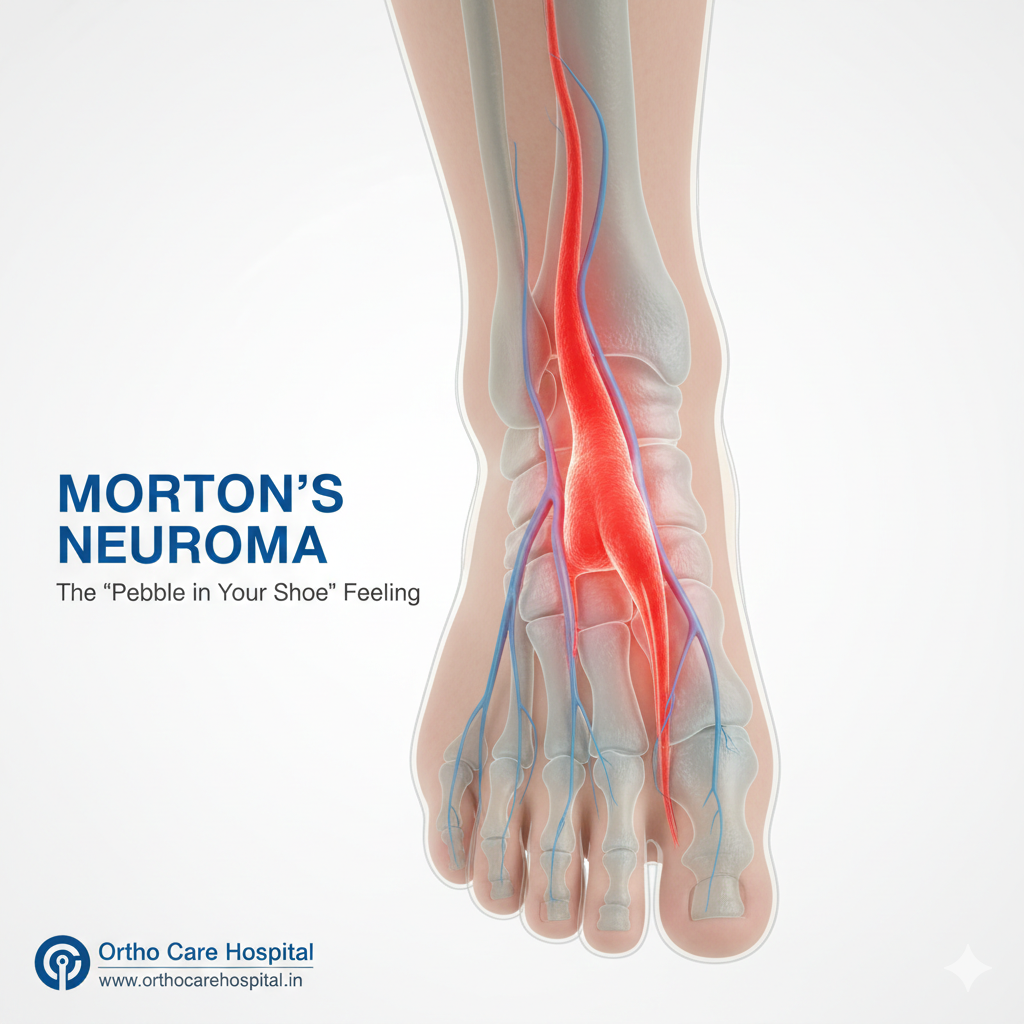
The “Pebble” Sensation: Recognizing the Symptoms
Morton’s Neuroma is unique because there is rarely an outward sign, such as a lump or redness. It is a “hidden” condition that is defined by how it feels:
- The Phantom Object: The hallmark symptom is the feeling that something is inside your shoe or bunched up under the ball of your foot.
- Burning and Tingling: A sharp, electric-like pain or “pins and needles” in the ball of the foot.
- Numbness: As the nerve compression worsens, the affected toes may feel numb or “dead.”
- The “Removal” Relief: Most patients find that the pain diminishes significantly the moment they take off their shoes and massage their feet.
The Culprit: Narrow Footwear and Biomechanics
Why does this thickening happen? The primary cause is compression and irritation.
1. The “Narrow Shoe” Factor
Vadodara is a city of fashion and activity, but high-heeled shoes or footwear with a narrow, tapered toe box are the leading contributors to Morton’s Neuroma. When the front of the shoe is too tight, it squeezes the metatarsal bones together. This constant “pinching” irritates the nerve, causing the protective tissue around it to thicken in response.
2. High-Impact Activities
Repetitive trauma to the ball of the foot—common in runners, dancers, or those who participate in high-impact sports like badminton or tennis—can aggravate the nerve.
3. Foot Deformities
If you already suffer from bunions, hammertoes, or flat feet (fallen arches), your foot mechanics are likely putting uneven pressure on the digital nerves, making you more susceptible to developing a neuroma.
Diagnosis: The “Squeeze Test”
When you visit Ortho Care Hospital, Dr. Sandeep Chauhan performs a thorough clinical evaluation. One of the most effective ways to identify Morton’s Neuroma is the Mulder’s Click or “Squeeze Test.”
By squeezing the metatarsal bones together with one hand and applying pressure to the affected space with the other, a “click” can often be felt as the enlarged nerve is pushed between the bones. To confirm the diagnosis and rule out stress fractures, we may recommend an Ultrasound or MRI.
Finding Relief: The Comprehensive Approach
As the Top Orthopaedic Doctor in Vadodara, Dr. Chauhan believes in a step-by-step treatment plan that begins with conservative, non-invasive methods.
Non-Surgical Solutions
- Footwear Overhaul: The first and most important step. Switching to shoes with a wide toe box and lower heels can provide immediate relief.
- Orthotics and Metatarsal Pads: Custom-made shoe inserts can help lift and separate the metatarsal bones, taking the pressure off the nerve.
- Injections: Corticosteroid injections can reduce the inflammation and swelling of the nerve tissue.
- Activity Modification: Temporarily avoiding activities that put repetitive pressure on the forefoot.
Advanced Treatment
For cases that do not respond to conservative care, we offer minor surgical interventions. A neurectomy involves removing the thickened nerve tissue or releasing the surrounding ligament to create more space. This is a highly successful procedure that allows patients to return to their active lifestyles.
Why Choose Ortho Care Hospital?
Choosing the Best orthopaedic hospital in Vadodara means choosing a facility that understands the intricacies of foot and ankle anatomy. We don’t just treat the pain; we analyze your gait, your footwear, and your daily habits to ensure the problem doesn’t return.
Dr. Sandeep Chauhan’s comprehensive approach ensures that whether you are a corporate professional walking the halls or an athlete on the field, your foot health is in expert hands.
Stop Walking on “Pebbles”—Find Relief Today!
Foot pain is not something you have to live with. If you are experiencing burning, tingling, or that annoying “fold in the sock” feeling, it’s time to consult a specialist.
Book Your Consultation at Ortho Care Hospital:
- Phone No: 093289 74527
- Address: 2nd Floor Sharnam Enclave, Above Kotak Bank, Subhanpura Main Road, New IPCL Road, Vadodara, 390023.