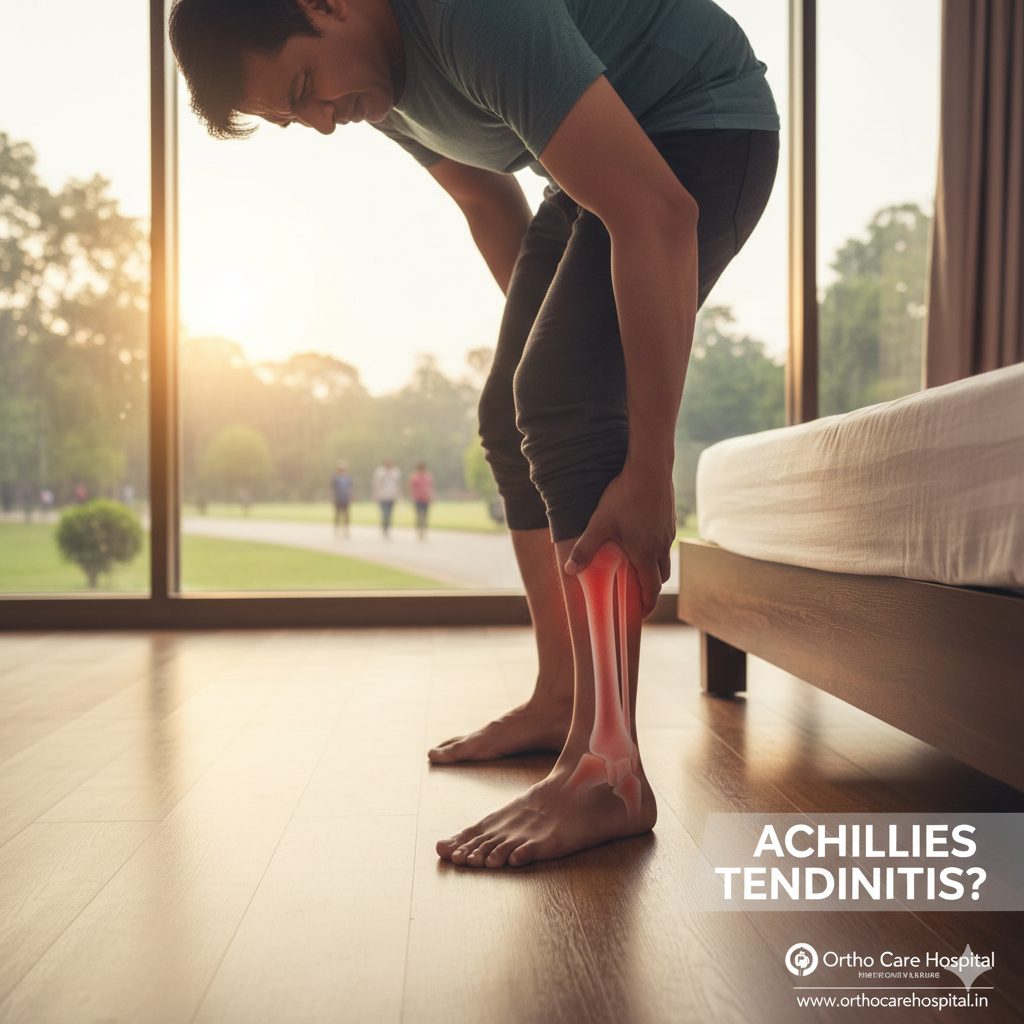
Waking up in the morning should be a refreshing start to your day. However, for many residents in Vadodara, that first step out of bed is met with a sharp, stabbing sensation at the back of the heel. If you find yourself limping toward the bathroom or feeling a localized stiffness in your calf that only eases up after you’ve “warmed up,” you are likely dealing with Achilles Tendinitis.
At Ortho Care Hospital, led by Dr. Sandeep Chauhan, the Top Orthopaedic Doctor in Vadodara, we see a significant rise in these cases whenever there is a shift in seasonal activity. Whether you’ve recently started a new morning walk routine at Sayaji Baug or increased your intensity at the gym, your heels might be paying the price.
What is Achilles Tendinitis?
The Achilles tendon is the largest and strongest tendon in the human body. It connects your calf muscles (gastrocnemius and soleus) to your heel bone (calcaneus). This powerhouse tendon is what allows you to push off the ground when walking, running, or jumping.
Achilles Tendinitis is an overuse injury that causes inflammation, irritation, and sometimes micro-tears in this tendon. Unlike a sudden rupture, tendinitis usually develops gradually due to repetitive stress.
Why Does it Happen? The “Too Much, Too Soon” Syndrome
The most common culprit behind Achilles pain is a sudden increase in activity. Your body is remarkably adaptable, but it needs time to adjust to new physical demands.
The Science of Micro-Tears
When you start a new morning walk routine or decide to take up jogging on the roads of Subhanpura, your Achilles tendon undergoes significant tension. If the intensity, duration, or frequency of this activity increases too quickly, the tendon fibers can develop micro-tears.
Normally, the body repairs these tears during rest. However, if you continue to put pressure on the tendon without adequate recovery time, the inflammation persists, leading to thickening of the tendon and chronic pain.
Contributing Risk Factors
- Improper Footwear: Walking in worn-out shoes or flat sandals that lack arch support.
- Tight Calf Muscles: When your calf muscles are tight, they pull on the Achilles tendon, increasing the baseline tension.
- Hard Surfaces: Running or walking on concrete rather than a cushioned track.
- Anatomy: Flat feet or fallen arches can put extra strain on the tendon.
Identifying the Symptoms
How do you know if your heel pain is actually Achilles Tendinitis? Look for these specific “Red Flags”:
- Morning Stiffness: A dull ache at the back of the leg or above the heel after waking up.
- Pain After Activity: While the pain might lessen during your walk, it often returns with a vengeance once you sit down and cool off.
- Visible Swelling: You might notice a “bump” or thickening on the tendon that is tender to the touch.
- Limited Range of Motion: Difficulty pointing your toes or pulling your foot upward.
Types of Achilles Tendinitis
It is important to identify where the pain is located, as this dictates the treatment plan provided by the Best Orthopaedic doctor in Vadodara.
- Non-insertional Achilles Tendinitis: Fibers in the middle portion of the tendon have begun to break down with tiny tears. This is more common in younger, active individuals.
- Insertional Achilles Tendinitis: This affects the lower portion of the heel, where the tendon attaches to the heel bone. This can happen to anyone, even those who are not active, and is often associated with bone spurs.

The Ortho Care Hospital Approach to Recovery
Under the expert guidance of Dr. Sandeep Chauhan, we emphasize a Comprehensive Approach to foot and ankle health. Treatment isn’t just about stopping the pain; it’s about fixing the underlying biomechanics.
Phase 1: Immediate Relief (The R.I.C.E Protocol)
- Rest: Switching to low-impact activities like swimming or cycling.
- Ice: Applying ice to the area for 20 minutes several times a day.
- Compression: Using elastic bandages to minimize swelling.
- Elevation: Keeping the foot above heart level.
Phase 2: Specialized Physiotherapy
At Ortho Care Hospital, we utilize targeted eccentric strengthening exercises. This involves lengthening the Achilles tendon while it is under weight, which has been scientifically proven to “rebuild” the tendon fibers.
Phase 3: Advanced Diagnostic Scanning
If pain persists, it is vital to check for the severity of the tears. We recommend a Foot & Ankle Scan (Ultrasound or MRI) to visualize the health of the tendon and rule out a partial rupture.
Phase 4: Modern Interventions
As the Best orthopaedic hospital in Vadodara, we offer advanced treatments such as:
- Custom Orthotics: Shoe inserts to correct foot alignment.
- PRP Therapy: Using your body’s own growth factors to speed up tendon repair.
- Night Splints: To keep the tendon stretched while you sleep, preventing morning stiffness.
Preventing Future Injury
To keep your morning walks enjoyable and pain-free, follow these tips:
- Warm-up: Never start a brisk walk with “cold” muscles.
- Gradual Increase: Follow the 10% rule—never increase your distance or time by more than 10% per week.
- Stretch Daily: Focus on calf stretches to keep the Achilles flexible.
Schedule Your Foot & Ankle Scan Today
Don’t let a minor ache turn into a major injury. Chronic Achilles Tendinitis can lead to a full rupture, which often requires surgery and months of recovery.
If you are struggling with heel pain, consult the Top Orthopaedic Doctor in Vadodara today. At Ortho Care Hospital, we provide the specialized care you need to get back on your feet.
Contact Information:
- Hospital: Ortho Care Hospital
- Expert: Dr. Sandeep Chauhan (Owner & Medical Director)
- Phone: 093289 74527
- Address: 2nd Floor Sharnam Enclave, Above Kotak Bank, Subhanpura Main Road, New IPCL Road, Vadodara, 390023.